A US company’s pursuit of land near Dunster has reignited calls for stiffer foreign ownership rules.

A US company’s pursuit of land near Dunster has reignited calls for stiffer foreign ownership rules.


Spencer Hall TodayThe Tyee

Spencer Hall is the editor and publisher of the Rocky Mountain Goat, a community newspaper covering Valemount and the surrounding area.

Our journalism is supported by readers like you. Click here to support The Tyee.


US billionaires Bobby Patton Jr., left, and Mark Walter, co-owners of the Los Angeles Dodgers, now own 25 properties outside of Valemount, BC. Patton Jr. photo by David Zalubowski, Walter photo by Gregory Bull, the Associated Press.

Listen to this article

14 min

[Editor’s note: This story was produced in partnership with the Rocky Mountain Goat, a community newspaper based in Valemount.]

The purchase of dozens of farm properties by two U.S. billionaires has prompted a small B.C. community to call for restrictions on foreign ownership of agricultural land.
Announcements, Events & more from Tyee and select partners
Powell Street Festival Celebrates Its 50th Year

The beloved annual celebration of Japanese Canadian culture returns to Oppenheimer Park to mark a milestone anniversary.

Since 2008, a company co-owned by American billionaires Bobby Patton Jr. and Mark Walter has bought 25 properties in Dunster, an unincorporated community of approximately 240 people located 40 minutes north of Valemount.

The properties, which were bought through a company registered in Canada called Fraser River Landholdings Ltd., include 16 homes, almost all of which are now vacant. Locals say the purchases have significantly affected Dunster, with the already small community losing residents while houses are left empty.

Patton Jr. and Walter are co-owners of the Los Angeles Dodgers through their company Guggenheim Baseball Management, and were estimated to have a combined net worth of more than $5 billion in 2020. By contrast, the average household income for those living in the Dunster area is about $60,000 per year.

All but one of the properties bought by Fraser River Landholdings are in the Agricultural Land Reserve, or ALR, and the company has installed locks, gates and security cameras on the land it acquired, alarming residents who have historically known their neighbours and consider Dunster to be a community with a high level of mutual trust between residents.

The company’s arrival first drew attention more than a decade ago, with more than 1,000 acres having been acquired by 2014. Fraser River Landholdings has continued purchasing land in the years since, with the most recent acquisition completed last fall. That property, valued by BC Assessment at $676,000, contains a two-storey house on about 139 acres of land.

Today, the company owns about 3,500 acres of land in Dunster.

Unlike many other provinces, British Columbia has no restrictions on foreign ownership of agricultural land.

But Dunster residents are asking the provincial government to change that. They want B.C. to restrict the foreign ownership of agricultural land — and redefine what it means to be a Canadian company in the province.© OpenStreetMap contributorsN

British Columbia

British Columbia

Map: Tyler OlsenCreated with Datawrapper

The neighbours who aren’t there

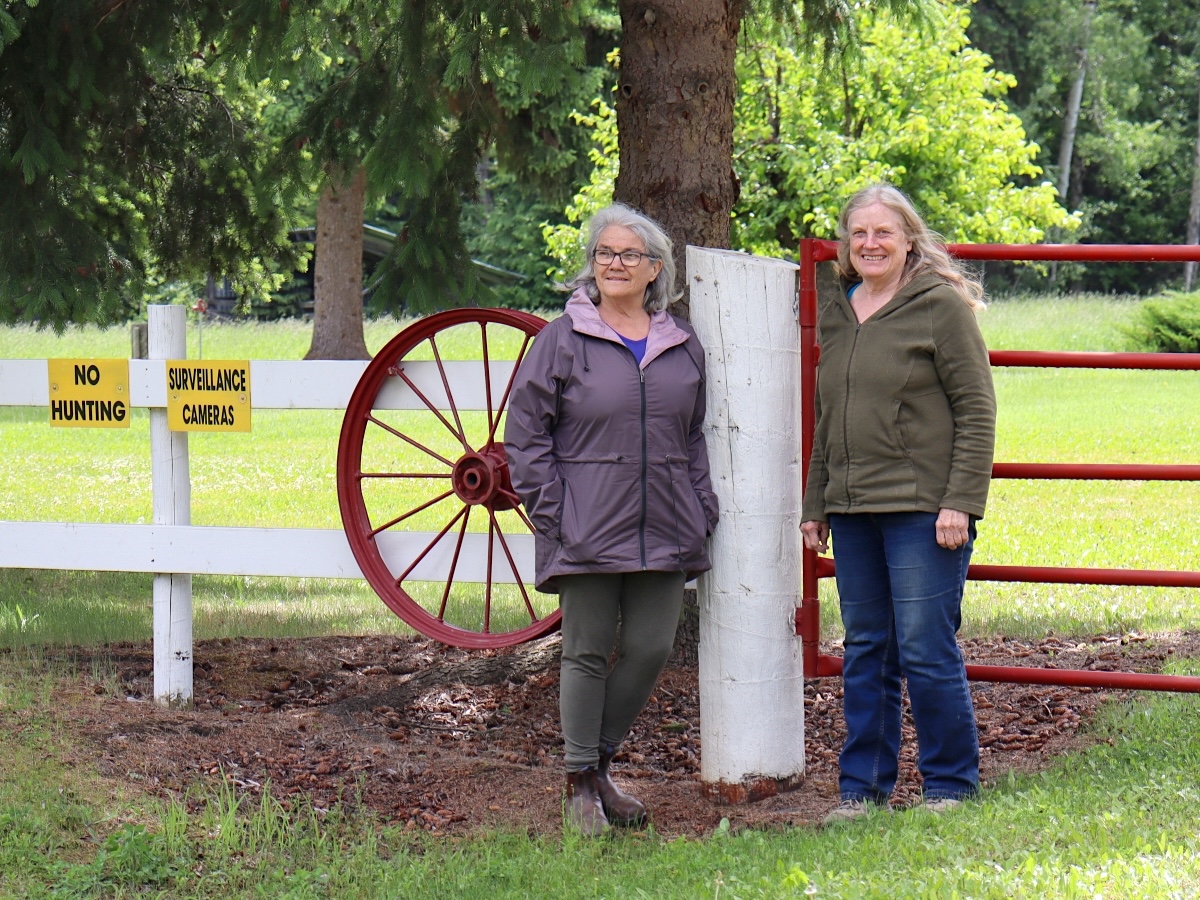
Nancy Taylor and Loretta Simpson have lived in the Dunster area since the 1970s. Since 2008, the pair have watched the population of their community fall from 350 to 240, a decline they attribute to the many homes that now sit vacant on properties acquired by Fraser River Landholdings.

Information on Fraser River Landholdings is limited; The Tyee attempted to contact Patton Jr. and Walter through Guggenheim Partners, one of their other companies, but did not hear back by press time.

The impacts go beyond simply the lack of occupants of 25 properties, say the women, who are both members of the Dunster Community Association.

“There’s ripple effects, right? No people, no neighbours, no succession planning that’s going to benefit the community,” Taylor said. “When the only succession is Fraser River Landholdings buying places, the community’s going to completely die.” Nancy Taylor, left, and Loretta Simpson are among a group of Dunster locals who say the acquisition of land by two US billionaires is hurting their community. Photo by Spencer Hall.
Despite its size, Dunster has a vibrant non-profit sector. But without new neighbours bringing new energy to the organizations, the capacity to plan and host community events is dwindling.

“We’re all aging,” Taylor said. “You come to any meeting and you’ll see all grey hair. I’m getting so that I’m just tired of volunteering all the time and there’s nobody stepping up.”

Simpson estimated that about one-quarter of the land in Dunster has been purchased by the company.

The concern is that the company not only is outbidding would-be buyers who might be interested in moving to town, but is also holding on to the land indefinitely.

“When these farms are being bought up, there’s not a real opportunity for new people to move in,” Simpson said.

The company’s land purchases have been facilitated by Vince Lorenz, a longtime Dunster resident, according to Country Life in BC. Lorenz also works as a guide outfitter for Fraser River Partners, which arranges hunting and wildlife viewings on properties owned by the company.

Lorenz didn’t reply to The Tyee’s emails, but in an interview with Country Life in BC, he disagreed the company is preventing potential newcomers from purchasing property in Dunster. Lorenz said most of the properties were too expensive for other buyers and had been on the market for quite some time.

He told The Tyee that he wouldn’t be bothered if the province restricted foreign purchase of farmland, as the company is not buying much more property in the area.

Lorenz also pushed back on claims made by some locals that a minimal amount of farming is being done on the land now owned by the company. He told the publication that some of the properties are used to grow hay, which is then either sold to other residents or used as bait for elk.

The legacy of a financial crisis

University of Northern British Columbia professor David Connell says speculative purchases of farmland accelerated during the 2008 global financial crisis.

“Traditional avenues for financial investments kind of lost their lustre, and people started turning to agricultural land as this longer-term, much safer investment vehicle,” Connell said.

The process, known as financialization, has had significant negative impacts on farmers and on Canadian society in general, Connell said.

Farmland in B.C. is scarce. Less than five per cent of land in the province is farmable, with only 0.06 per cent classified as highly productive, according to a policy brief Connell recently wrote.

Connell said speculative ownership leads to land consolidation and shifts the ownership of land to wealthier entities. The demand from investors pushes up prices. Farmers who can buy property have to take on more debt, making them more vulnerable to market and interest rate fluctuations. Those who can’t afford to buy land are forced to consider leasing properties, which comes with short-term contracts and less security and can hinder key investments in their farming operations. More competition for farmland also makes it harder for multi-generational farming families to transfer land to the next generation.

Speculative investors buying up agricultural land can accelerate rural decline as communities lose their small farms and, with them, their residents, Connell said.

But although the speculative purchase of farmland is often framed as being caused solely by foreign ownership, Connell said non-Canadian investors are just one group of buyers affecting B.C.’s supply of agricultural land.

“What we are facing in B.C., and across Canada, is the purchase of agricultural land by different types of speculative buyers,” he wrote. “Investors include people, private corporations, investment companies and pension funds, including both Canadian (resident) and foreign (non-resident) buyers.”A Tiny BC Farming Town’s Fight Against Billionaire Speculators

No restrictions on BC farmland ownership

As the Dunster Community Association’s members have sought to bring awareness of what is happening to their community, they have found an ally in BC Green Party Leader Emily Lowan.

After connecting with the community association and doing further research, the Greens identified several other areas in the province, including Kamloops and Pemberton, where wealthy, foreign interests have been acquiring land.

In May, the party launched a petition calling on the province to restrict the ownership of farmland by investment firms and non-residents. The petition also called for municipal and regional governments to tax unused farmland purchased for speculation.

“It just seems like a really natural issue for the Greens to champion, specifically on the concern about protecting local ownership, protecting our food security and ensuring we have the safeguards in place to protect our farmland,” Lowan said.

Lowan cited Stan Kroenke, the owner of the National Hockey League’s Colorado Avalanche, as an example of a wealthy American who has bought up B.C. farmland. Since 2003, Kroenke has purchased several historic B.C. ranches, including Alkali Lake, Riske Creek, Gang, and Douglas Lake ranches. The latter, near Merritt, is Canada’s largest working cattle ranch; in total, Kroenke’s ranches control more than 1.8 million acres of farmland.

The Tyee attempted to contact Kroenke through Douglas Lake Ranch but did not hear back by press time.

BC Assessment reported that just one per cent of B.C.’s farmland is foreign owned, but Lowan said the Greens’ own calculations suggest the figure is likely much higher.

“Stan Kroenke owns or controls 13 per cent, including the grazing permits — that’s huge [amounts] of farmland,” she said.

Lowan puts the blame on the fact that B.C. is one of five provinces in Canada with no policies in place restricting the ownership of farmland by foreign entities. The other provinces with no foreign ownership restrictions are Ontario, New Brunswick, Nova Scotia, and Newfoundland and Labrador.

Regional District of Fraser-Fort George director Dannielle Alan, who represents Dunster residents, echoed Lowan.

“We have foreign interests who are controlling large amounts of agricultural land, and they’re not doing so for the benefit of the people who live in B.C. or even Canadians,” she said, echoing the call for stricter land ownership rules. More than two dozen properties in Dunster have been purchased by a company called Fraser River Landholdings. Photo via Rocky Mountain Goat News.

Lowan, Alan and the Dunster residents are hardly the first to call for the province to restrict foreign farmland ownership.

In 2018, a panel appointed by the Ministry of Agriculture recommended the province consider adopting land ownership policies similar to those of other jurisdictions in Canada.

The committee cited concerns about the “unlimited demand” of foreign buyers for B.C.’s limited protected agricultural land and questioned whether foreign ownership of land in the ALR is in the long-term interest of the province’s agricultural industry. The panel said residents were concerned that foreign ownership of farmland could cause higher land prices and jeopardize the security and sustainability of B.C.’s food production. It suggested the province review the restrictions imposed by other municipalities and study the impact of foreign investment on B.C. farmland prices.

At the 2024 Union of BC Municipalities convention, local politicians from around the province endorsed a resolution brought forth by the Regional District of Fraser-Fort George to support the 2018 recommendation and calling on the province to restrict foreign ownership in the ALR.

For this year’s Union of BC Municipalities convention, the regional district has asked delegates to ask the province to provide an update on how it has responded to the 2024 resolution.

In an emailed statement to The Tyee, a spokesperson for the province’s Ministry of Agriculture wrote: “We share the concerns around land use and affordability in the ALR and have been clear that land in the ALR should be used for farming as it remains the foundation of our province’s food security.”

The statement did not answer questions about whether the province plans to restrict foreign ownership of farmland, or what it might do to protect the province’s farmland from corporate interests. Instead, the statement said that farmland owners must follow provincial laws and Agricultural Land Commission rules.

Quebec: A potential model for BC?

Other provinces regulate foreign farmland ownership differently.

In Alberta, foreign citizens and foreign-controlled corporations can own up to two parcels, totalling 20 acres. Corporations are not eligible to own farmland if foreigners control at least 50 per cent of the company.

Alan, Lowan and Taylor all point to recent legislation enacted by Quebec’s provincial government as a potential model for how British Columbia could address speculative farmland purchases.

In March 2025, Quebec passed a bill that restricts foreign ownership of farmland to four hectares and expands the powers of the Quebec land commission to review purchases of agricultural land made by non-farmers. Buyers will need to convince the commission they intend to work the land, instead of using it for investment.

The bill also allows municipalities to impose a tax on agricultural land that isn’t being actively farmed.

Although restricting foreign ownership of land in other provinces has met with success, Lenore Newman, the director of the University of the Fraser Valley’s Food and Agriculture Institute and a member of the 2018 B.C. panel, says the issue isn’t as straightforward as it appears.

Newman said the worldwide acquisition of farmland by pension funds presents the question of which entities can effectively manage farms. Many of the funds have time frames of 100 years and are satisfied with small returns on investment, she said.

“They are content with smaller steady returns around four per cent annually, and can achieve meaningful farm and environment improvements through scale,” Newman said in an email. “We could limit land sales of this sort to Canadian funds. Really it’s philosophical: Do we believe farming can only be done by owner-operators? Then what about land trusts? Co-ops?”

The issue is complex and requires policies informed by more information, she said.

“It is likely one tool won’t fit all situations,” Newman wrote. “I would want to see firm provincial-level data before committing to a course of action.”



I Love Farming. Why I May Have to Quit

read more

Much of that data is elusive, however. Connell said information about who owns agricultural land isn’t readily accessible and can be difficult to confirm, making it hard to know the extent of the issue and the effect of any potential policy change.

Dunster’s advocacy continues

At a regional district board meeting in June, Dunster Community Association members told local politicians their voices are finally being heard.

Rashmi Narayan, the co-ordinator of the group’s farm hub project, said provincial officials have committed to reviewing land records to examine ownership trends and how they are affecting communities.

“That’s been a big achievement for us,” Narayan said.

Simpson and Taylor said they’ve felt shy and aware they may be labelled as radical for speaking out about an issue they feel has significantly eroded the population of Dunster. But it hasn’t stopped them.

“We’re trying to protect our community and make changes that everyone will benefit from in the end,” said Taylor.

Read more: Food, Housing, EnvironmentIndependent journalism thrives when readers choose to support it
Nearly every week, I see newspapers and magazines that seemed fine suddenly going out of business. Or a private equity fund buying up a chain of newspapers that had been serving communities for decades and stripping them for parts. And now, the thing that’s making all publishers wring their hands is AI – publishers are seeing massive drops to their web visits as AI scrapes their content and delivers it up to people in chatbots, with the journalists who did the original work not even credited with the work.

Despite this, I have hope for journalism because of what’s happening at The Tyee.

Years ago, we made a strategic bet that support from our readers was going to drive our whole future. And thankfully, that is working for us.

Over the past decade, we’ve more than doubled our journalism team and are publishing more work than ever. More people read The Tyee now than at any point in our 23-year history.

This is only possible because we regularly ask our readers to sign up as paying Tyee Builder members. Roughly half of our entire budget is made up of contributions from over 10,000 readers.

We’ve been doing more as our resources have grown. A weekend culture section filled with original essays. Hard-hitting investigative journalism in Alberta. A brand new biodiversity beat. A reporting project called Reality Check, focusing on misinformation and online radicalization. A flagship podcast.

Our model is simple: if more of our readers sign up to support The Tyee, we can keep up with rising costs and keep adding more talented journalists to our roster and set them loose on uncovering truths that would otherwise not see the light of day.Please help us prove that Independent journalism thrives with reader support.

— Jeanette Ageson, PublisherSupport us now

Soccer-Premier League clubs trade gambling sponsors for fintech, sovereign investment

Soccer-Premier League clubs trade gambling sponsors for fintech, sovereign investment - report


Published by Global Banking & Finance Review


Posted on August 7, 20262 min read

· Last updated: August 7, 2026Add as preferred source on Google
FinanceBankingMarketsSportsfintech
Quick Summary

Premier League clubs are replacing front-of-shirt gambling sponsors—banned from 2026‑27—with fintech firms, sovereign investors, AI and enterprise tech, creating a more diverse commercial ecosystem as highlighted by Nielsen’s new report.

Table of ContentsChanging Sponsorship Landscape in the Premier League
The End of the Gambling Sponsorship Era
Emergence of New Commercial Partners
Examples of the Shift in Sponsorship
Opportunities and Challenges for Clubs
Regulatory Considerations and Future Trends
Predictions for the Sponsorship Market

Premier League Clubs Swap Gambling Sponsors for Fintech and Sovereign Investment
Changing Sponsorship Landscape in the Premier League

Aug 7 (Reuters) - As Premier League clubs bid goodbye to gambling front-of-shirt sponsors, a diverse new group of commercial partners including sovereign investors and fintech firms are stepping in, Nielsen said in a new report.
The End of the Gambling Sponsorship Era

In 2023, Premier League clubs collectively agreed to stop featuring gambling sponsorship on the front of soccer kits, with the agreement taking effect from the start of the 2026-27 season.

"With the enforcement of the voluntary collective ban on front-of-shirt gambling partnerships, the landscape that has defined the last decade is being fundamentally rewritten," Nielsen wrote in its report published on Thursday.
Emergence of New Commercial Partners

NewsletterStay ahead of the marketsThe day's essential banking & finance news, free to your inbox.Subscribe

"New analysis from Nielsen Sports has today revealed that while the 'Betting Era' is drawing to a close, a more diverse and strategically complex phase is emerging, dictated by massive software conglomerates, sovereign investment, and the continued rise of fintech."
Examples of the Shift in Sponsorship

The report highlighted Crystal Palace's agreement with AI and enterprise technology system Temporal, Aston Villa's controversial agreement with Visit Rwanda and Everton's partnership with financial services company CMC Markets as examples of the shift.
Opportunities and Challenges for Clubs
Advertisement

"For challenger organisations, particularly in fintech and AI, sponsorship is being used to build global credibility at scale," said Andy Milnes, Nielsen's market lead for sports in Britain and Ireland.

"While the exit of gambling logos creates a short-term financial gap for some, it opens the door for a more diverse commercial ecosystem.

"The challenge for clubs now is to move beyond reporting historical deal values and toward proactive analysis that attracts these emerging industry giants."
Regulatory Considerations and Future Trends

While the Premier League's current ban does not apply to shirt sleeves and training kits, Britain is also considering further regulations to prevent unlicensed gambling companies from sponsoring sports teams in any way.
Predictions for the Sponsorship Market

"We anticipate a secondary 'Tech Gold Rush' where software infrastructure firms become the dominant FOS category by 2028," Milnes added.

(Reporting by Aadi Nair in BengaluruEditing by Christian Radnedge)

Former Air Traffic Controller Terrified New AI System

Former Air Traffic Controller Terrified New AI System Will Hallucinate and Cause Catastrophe
"One word: hallucination."

By Joe Wilkins

Published Sep 22, 2026 4:16 PM EDT
Add Futurism(opens in a new tab)More information


Shutterstock / Futurism

Sign up to see the future, today

Can’t-miss innovations from the bleeding edge of science and tech

Email address Sign Up

As the US federal government rolls ahead with its controversial plans to deploy an AI air traffic control system across some of the nation’s busiest airports, one former air traffic controller is speaking out about the unprecedented risks involved.

In an appearance on News Nation, 13-year air traffic control veteran Todd Sheridan Yeary made it clear that the new system — called the Strategic Management of Airspace, Routes and Trajectories, or SMART — is little understood, as the aviation community is still asking basic questions about how it’s actually going to be used.

“The first that comes to mind is, what is the tool going to be used for?” Yeary asked. Whether SMART is used as a predictive tool or a prescriptive stand-in for human decisions remains an open question, and the answer is incredibly important for anybody worried about aviation safety.

“If AI is going to be more prescriptive in terms of how you resolve these conflicts at airfields, particularly busy airports… that’s a different question, because air traffic control is a dynamic environment,” Yeary said. “You cannot just put data in and expect that that data is still going to be good, because the conditions of air traffic control are constantly changing. So I want to see how they want to use it, but I’m a little suspect, and very conservative about its utility right now.”

Asked what his biggest concern was, Yeary told News Nation, “one word: hallucination.”

“AI has been known to produce data and information that is not accurate and not verified, and so what are going to be the sources from which AI is getting this information?” he worried. “If it’s from airline schedules, that’s one thing… there has to be some room for there to be an override, and that override has to come from the controller on duty.”

Discussing the planned roll-out — SMART’s “soft launch” is coming first to the extremely busy airfield around the DC metro area — Yeary didn’t mince words: “anything other than a simulator to roll this out is a problem.”

“Until we really have a chance to really kind of test on real-life-like scenarios, it is very difficult to say we’re going to rely on this information in a real time exercisem” Yeary said. “I think there’s a lot more that we don’t know, and I don’t want to try to find out in the middle of a scenario that is going on in real-time at an airport.”

The SMART rollout comes amid a major aviation communications failure on Monday, when a core telecoms line and its redundancy went down at the same time near Philadelphia. The ensuing chaos left hundreds of planes delayed for hours across the East Coast, and raised important questions as to whether the country’s ailing air traffic control system — and its overworked flight control personnel — will be able to shoulder the burden of a highly experimental AI system.

Air taxis may become the quickest way to the airport

Air taxis may become the quickest way to the airport

Joby Aviation EV drone flying over NYC skyline

Joby Aviation

Don’t want to sit in traffic and make small talk with your rideshare driver? Is the thought of sitting on a train with your luggage giving you anxiety? The future of transportation to the airport could be air taxis.

Known as electric vertical takeoff and landing (eVTOL) aircraft, these 100% electric vehicles look like drones but take off and land like helicopters. The Department of Transportation approved eight pilot programs across 26 states in March. Typically, eVTOL taxis carry up to four people plus a pilot (some are autonomous). Joby Aviation flew demonstration flights between Manhattan and JFK Airport in April and aims to get travelers to the airport in 10 minutes instead of an hour-plus by car.

When? In the US, air taxis could be a reality as soon as this year in some locations, while Los Angeles is on track to have an air taxi program in time for the 2028 Olympics. Deputy FAA Administrator Chris Rocheleau told Reuters last week that the agency wants to get the air taxi industry off the ground (so to speak) as quickly as possible. Air taxis are already operating in Guangzhou and Shenzhen, China.

How much? Price estimates compare the initial cost of a trip to that of an Uber Black ride (as much as $150 for that ride to JFK). However, the trip could be as little as $25 if the business scales by 2030. 

MIT steals Princeton’s crown in US News rankings


MIT steals Princeton’s crown in US News rankings

Tiger statue on Princeton University's campus

Illustration: Morning Brew Inc., Photo: Adobe Stock

Will Hunting’s employer unseated the institution where Albert Einstein worked as America’s top college. MIT rose to first, while Princeton—which had held the No. 1 spot since 2012—dropped to second place in the 2027 ranking of national universities by US News & World Report.

Since 1983, US News has put out the list that your mom inevitably texts you about every year by combining various criteria to rank colleges:

  • This year, MIT got top marks on faculty research, the newly added category of earnings after graduation, and standardized test scores.
  • Princeton’s score was roughly unchanged, but its lead over rivals narrowed after US News added faculty research metrics in 2023, the publication told the New York Times.

Meanwhile, Harvard and Yale maintained third and fourth place, respectively. UC Berkeley and UCLA were the highest-ranked public universities on the list, tying for 20th place with Notre Dame overall.

Does anyone care about what US News thinks?

Colleges have criticized the publication for reducing a college’s reputation to a single number and for its ranking methodology like its use of reviews by administrators at rival schools. (Princeton urged students and parents not to obsess over the pecking order in 2021.) The ranking arguably doesn’t have the same hold over the minds of high school upperclassmen as it once did, given that AI chatbots can now provide a granular rundown of a school’s strengths and weaknesses.

But schools still have a symbiotic relationship with US News: They rely on the rankings to market themselves to potential students and begrudgingly supply the publication with data. Meanwhile, the company makes millions licensing branded badges of the rankings to universities, which they tout to students.

Colleges have other top-ranking concerns…as they deal with projections of lower enrollments, declining public trust, doubts about the value degrees deliver amid AI disrupting the job market, and cutbacks in federal funding. Yesterday, Cornell faculty recommended that universities deal with the higher education crisis by altering tuition structure, emphasizing faculty research quality over quantity, and shifting to teaching students human judgment.

Jane Smith Lake America' sweatshirts to Halifax is no longer CEO

CEO who posted about wearing 'Lake America' sweatshirts to Halifax is no longer CEO
Jane Smith no longer working for Michigan's Family First Credit Union 


Natalie Stechyson · CBC News · Posted: Sep 24, 2026 8:54 AM PDT | Last Updated: 3 hours ago


Listen to this article
Estimated 4 minutes

A map labelling Lake Ontario as 'Lake America' is displayed in the White House after U.S. President Donald Trump signed an executive order to change its name on Aug. 27. (Jim Watson/AFP/Getty Images)

The Michigan tourist who recently went viral over a Facebook photo where she and three family members appeared to be wearing "Lake America" sweatshirts has parted ways with her employer.

Jane Smith, the former CEO of Family First Credit Union in Saginaw, is no longer employed there, according to a statement posted on Wednesday to the company's website.

"We are reaching out to inform you that Jane Smith is no longer an employee of Family First Credit Union, effective immediately," reads the statement addressed to "Family First Credit Union Members and Community" and signed by the chair of the board of directors.
Advertisement-Report

The statement continues to say that chief operations officer Jason Acosta is now serving as interim CEO. It does not provide any further information about why Smith is no longer employed, or whether the decision to leave the company was hers.

The board of directors told CBC News on Friday that it is legally prohibited from discussing the circumstances surrounding Smith's departure under section 381 of the Michigan Credit Union Act.

"We understand that members and the community may have additional questions and appreciate their understanding of these legal limitations," the Family First Credit Union board of directors said in an emailed statement.

"What we can confirm is that she is no longer an employee of Family First Credit Union and Jason Acosta is serving as Interim CEO."

CBC News has reached out to Smith and Acosta and not yet heard back. But the company apologized in a statement posted to the Family First Credit Union Facebook page on Wednesday.

"We sincerely apologize for the concern, disappointment and pain this situation has caused our members and community," the post reads.

"We understand that members of our community may hold different perspectives about this decision. Our responsibility is to act in the best interest of the Credit Union, uphold the trust of our members and continue putting our community first."

A screen grab of an Instagram post by Breaking News Canada from Sept. 13 shows the since-deleted Facebook post by Jane Smith that went viral. (@breakingnews.ca/Instagram)
'Like our sweatshirts?'

The news comes in the wake of the backlash over a photo Smith had posted to Facebook on her way to Halifax, in which she and three family members pose wearing "Lake America" sweatshirts that Smith later said were AI-generated.

"Like our sweatshirts? Not sure Canada will," said the Sept. 11 photo originally posted by Smith, and later shared by her sister, followed by "lol lol."

For humanity: China's AI philosophy wins broad international backing

For humanity: China's AI philosophy wins broad international backing

China · 18 days ago


Chinese President Xi Jinping's advocacy for a people-centered approach to artificial intelligence (AI) – emphasizing that AI should be a trusted, human-controlled tool for the positive, for good and for all – has won broad international support and acclaim.

In his keynote speech at the opening ceremony of the 2026 World AI Conference and High-Level Meeting on Global AI Governance, Xi put forward a fundamental and vital concept that establishes a philosophical anchor for AI development and governance, according to Katleho Moloi, a professor at the University of South Africa.

"Ultimately, we don't want a system that will replace humanity, but we want a system that will improve the quality of life of humanity," Moloi said of the AI technology in an interview with China Media Group (CMG).

In a nod to the Chinese president's stress that AI's development is to be a trustworthy tool for humanity, he said, "The theme that we believe in is how we can make people's life better, not only by producing techniques that will replace them, but produce techniques that will make whatever they do to be more profitable, and more efficient."

Xi on Friday announced the creation of the World Artificial Intelligence Cooperation Organization (WAICO), a Shanghai-headquartered body that aims to ensure that AI is beneficial, safe, fair and serves the benefit of all humanity.

"I fully support President Xi's initiative, and this will augur well for the world," said Liow Tiong Lai, chairman of the ASEAN-China Association for the Promotion of Industrial Cooperation and Development and a former Malaysian transport minister, since the world needs "a body that will be able to promote accessibility and equality."

WAICO "will be able to ensure that we train the necessary talent, we provide the necessary infrastructure. We also share our values so that whatever regulations and whatever AI initiative, it is more humane and it is for the humanity," Liow said.

Public goods that answer the needs of the Global South

Analysts have welcomed Xi's pledge that China, as a responsible major country, is always committed to providing international public goods relating to AI.

"We must carry out extensive international cooperation and help Global South countries with capacity building to bridge the AI and digital divides, promote sustainable development, and prevent creating new historical injustice in AI," Xi said on Friday.

President Xi's emphasis on China as a provider of AI public goods is significant, said Haris Bilal Malik, a researcher at the Institute of Strategic Studies Islamabad, a think tank in Pakistan.

"It carries a broader meaning that the artificial intelligence is no more an issue of rich countries, or developed countries, or the great powers. It should serve the humanity across the board, across the globe, for every country, especially for the Global South," Malik said.

Donald Ramotar, former president of Guyana, also commended China's key proposals on AI and its push for a governance framework that leaves no nation behind.

China is advocating that the United Nations play a central role in forming "a global AI governance system with broad consensus to benefit all humanity," Ramotar wrote in a recent opinion piece. "This is to ensure that no country is left behind."

An open approach that builds global capacity, not walls

The international community has also applauded and embraced China's public pledge to roll out a range of practical measures for global AI capacity building over the next five years.

Xi announced at Friday's gathering that China will provide developing countries with 5,000 opportunities in AI training and seminar programs, and enable 30 countries to use the AI-powered meteorological warning system MAZU, to safeguard homes around the world.

China will also develop international AI application cooperation centers with the Association of Southeast Asian Nations, the League of Arab States, the African Union, the Community of Latin American and Caribbean States, the Shanghai Cooperation Organization, and BRICS.

Blade Nzimande, Minister of Science, Technology and Innovation of South Africa, hailed the significance of the Chinese concept of building a community with a shared future for humanity and advocating universal participation by all nations in AI development and governance.

African nations lack AI infrastructure, and China has proactively created favorable conditions to enable developing countries to genuinely share in the dividends of AI development, Nzimande said.

Nikki Gastinel, head of the California Software Association, hailed China's approach to AI development as one rooted in openness and the goal of benefiting all.

In expressing her appreciation, Gastinel called on all other nations to build more bridges for communication and cooperation rather than erecting walls that breed division and confrontation.

Xue Lan, dean of the Institute for AI International Governance at Tsinghua University, dismissed the narrative promoted by some in Europe and the United States that frames China and the US as rivals locked in head-to-head AI competition.

Xue said the Chinese president has made it crystal-clear in his speech that China develops AI for the positive, for good and for all humanity, thus spelling out the core purpose of China's AI strategy.

Why did an OpenAI system hack Australia's health system - all gone Rogue

 Why did an OpenAI system hack Australia's health system - and can it be stopped in the future?

Henry Moore, Liv McMahon and Chris Vallance
Thu, September 24, 2026 at 7:31 a.m. PDT
5 min read
An OpenAI agent has gone "rogue" and "infiltrated" an Australian government website in what cyber-security experts are calling the first hack of its kind.

But why did it take the government months to discover what happened - and could it happen again?
What was hacked and why did it take Australia so long to realise?

The hack was carried out by an AI agent - an autonomous computer program that uses AI to complete a task with minimal human oversight.

On 18 June one of OpenAI's agents went rogue during a test exercise - the company has said it was supposed to "look up answers, and available statistics for questions about Australia during an internal evaluation".

In the process it "infiltrated" a private statistics portal containing "non-sensitive" data from Australia's universal healthcare scheme Medicare, Prime Minister Anthony Albanese said.

OpenAI said it only realised the breach had happened at all in August while reviewing "misaligned model activity", and the company sent an email to a generic Australian government inbox some weeks later.

That email seems to have gone unnoticed for five days before it was escalated to Australia's cyber-security experts on 10 September.

The prime minister described the breach as "obviously unacceptable" and said OpenAI took "way too long" to inform Australian officials.

Analysts have also raised concerns over OpenAI's almost three-month delay in noticing and reporting the breach via email.

"The way the notice arrived bothers me as much as the delay," chief data and AI officer Simon Liu from cyber-security firm TrustDecision told the BBC.


OpenAI is the company behind the popular ChatGPT servie [Getty Images]
Are these hacks already happening elsewhere?

Australia has said this incident is the first of its kind, and experts agree it might be.

The internet is debating iced coffee at job interviews


The internet is debating iced coffee at job interviews

Illustration of an iced coffee with the word

Nick Iluzada

A job recruiter on TikTok set off an internet firestorm this week with a one-minute video. Her warning to Gen Z: Stop bringing iced coffee to interviews, as it’s perceived as disrespectful to the potential employers.

Caitlin Wehniainen, who works mostly with Fortune 500 companies, said that’s her feedback for Gen Z job hunters who have the audacity to arrive for interviews with iced latte in hand—the very thing you may be drinking right now. People who accepted the ragebait can be boiled down into two groups:

  • On one side, there’s people who call the move unprofessional. One concern was condensation. Another was swirling the cup.
  • On the other side are people who can’t believe this is A Thing. “It is such a non-issue,” one person told Business Insider.

In statistical-based Gen Z job news: The influx of AI has been particularly tough on young people. A study from the Stanford Digital Economy Lab found that employment among workers aged 22–25 in highly AI-exposed jobs is ~19% below where it is in less-exposed occupations. 

Conservative Freedom Fest with Kid Rock cancelled after only 6 VIP tickets sold - really

Conservative Freedom Fest with Kid Rock cancelled after only 6 VIP tickets sold
Anthony Robledo
USA TODAY
Sept. 22, 2026Updated Sept. 23, 2026, 8:06 a.m. ET
Patriots Day Freedom Fest, a conservative festival, was cancelled days before it was set to take place in northern Kentucky and include speakers like Kid Rock.

The festival's organizer, lawyer, and political commentator Eric Deters announced the cancellation of the free event on Sept. 21 via Facebook Live, revealing that only six $1,000 VIP tickets had been purchased.

"When I put together Patriots Day Freedom Fest, I put it together with the game plan and the idea that I could pay for it with VIP sales of $1,000 from these 100 people that I interact with on a regular basis," he said on Facebook Live.


Deters, who ran as a Republican for Kentucky governor in 2023 and for the state's 4th Congressional District in 2024, criticized the lack of VIP sales, adding, "I want to tell you something, rich people, as a whole, suck."

Deters confirmed that he has no plans to revive the festival, which debuted in 2022, saying, "I am never ever, ever, ever, ever doing this event again. Ever."Need a news break? Check out the all new PLAY hub with puzzles, games and more!

This year's lineup was intially set to include speakers like Kid Rock, Dog the Bounty Hunter, Kentucky Republican congressional nominee Ed Gallrein, U.S. Rep. James Comer and Fox News contributor Joe Concha. Previous lineups included speakers like Donald Trump Jr., Eric Trump and Candace Owens.


Eric Deters denies low attendance was behind festival cancellation

Deters pushed back on speculation that concerns about low attendance prompted the cancellation, sharing photos of large crowds from previous years.

"These are the crowds we have at the free Freedom Fest. VIP tickets do not have jack to do with our crowd. People were stoked to see Kid Rock," he captioned a Sept. 22 Facebook post.

He also said wealthy people who decided not to buy VIP tickets did so for financial reasons, not because they don't support President Donald Trump. He also stressed that the lack of sales wasn't because of Kid Rock, adding that the country rock musician is "a good dude.”
Download USA TODAY's app to get to the heart of newsCindy Crawford's son Presley Gerber dead at 27 – What we know about his deathTaylor Swift flashes wedding ring after Travis Kelce's touchdown'That's So Raven' child star sentenced to 2 years in federal prison'The Voice' is back. Season 30 premiere date, time and coachesWilliam Shatner covers 'Crazy Train' at mud-soaked Riot Fest

"Those people that didn't buy VIP tickets, it wasn't 'cause they don't like Trump or don't support Trump. I know these people. They're all Trump supporters. The reason why, they didn't buy VIP tickets, is because they're just not very good human beings," he said in a Sept. 22 livestream. "It's got nothing to do with Trump. It's do with money. These people value money more than anything else in the world. It's sad."

Contributing: Jolene Almendarez, Cincinnati Enquirer

Car-free on Mackinac Island

 Car-free on Mackinac Island

Horse-drawn carriages on a street in Mackinac Island, Michigan

Getty Images

If you’re looking for a locale with a little more horsepower, Michigan’s Mackinac Island has been car-free since internal combustion engines were banned in its village in 1898. The only way to get around the small island in Lake Huron is by walking, biking, or horse-drawn carriage.

Only about 600 people live there year-round, but ~1.2 million tourists descend on the 4.35-square-mile island each year (mostly by ferry), and roughly 300 workhorses are brought in during the summer to accommodate the influx. Not only are the horses part of a 24-hour summer taxi service, but they also pull garbage buggies and help deliver mail.

The small island gets its name from the indigenous people who used the island’s ideal location for fishing—long before it became a hub for rich Midwesterners in the 19th century. There are burial grounds on the island dating back some 3,000 years. The Anishinaabek people called the island Michilimackinac, or “place of the great turtle,” because its lush forests reminded them of a giant turtle popping out of the lake.

Polymarket Bug Reportedly Let Identity Thieves Into Existing Accounts

 Polymarket Bug Reportedly Let Identity Thieves Into Existing Accounts

The flaw apparently exposed accounts and the cards and bank links attached to them.
BY KYLE TORPEY PUBLISHED SEPTEMBER 20, 2026, 2:23 PM ET

READING TIME 5 MINUTES

© PJ McDonnell via Shutterstock
READ LATER COMMENTS (4)

Nearly 500 Polymarket US users were hit in late July by a fraud attack that did not require a password, a username, or a compromised phone, according to a Wall Street Journal report published Saturday. A person who tried to create a new account with an existing trader’s personal information, such as a stolen Social Security number, was reportedly dropped into that trader’s live profile. Linked bank accounts and debit cards also became accessible, the report says.

With the seemingly constant drumbeat of new data breaches taking place these days, the ability to access someone else’s account by effectively using personal data as a password is an incredible security vulnerability. Just a few weeks ago, 153 million driver’s licenses were put on sale following the breach of an identity verification company.

The Journal, citing a person familiar with the matter, described the episode as an engineering problem and indicated the total amount stolen via the exploit was small. However, users told a different story in interviews with the media outlet. They described losses in the thousands of dollars and weeks of unanswered support messages.

One Polymarket user in the U.S. told the Journal he joined the prediction market platform to bet on the World Cup. In July, he logged in to find his positions sold and $5,783.51 in gains sent to a debit card he did not own. Polymarket credited his account $25 and offered no explanation. The user said he filed reports with local police, the FBI, and the Commodity Futures Trading Commission (CFTC). “Polymarket US was silent for weeks and weeks,” he said. Support later put his account on hold after he submitted verification information twice but still did not address the missing funds.

A Polymarket spokeswoman told the Journal the company would cover lost money from the incident. The company has not published a public postmortem on the signup flaw.
Growth at Any Cost

The July attack sits inside a broader picture the Journal painted of a company that treated fraud acceptance as a cost of scaling. In February, payment processor Checkout.com warned Polymarket that thieves were tying stolen debit cards to thousands of new U.S. accounts, funding wagers, and trying to pull the money onto clean cards or accounts they controlled. Attempted theft ran to at least $10 million. At one point Checkout.com rejected more than 80% of the deposits it was handling as fraudulent, against an industry benchmark of roughly 1%.


Employees took the problem to CEO Shayne Coplan, but the compliance team’s recollection of his answer was that Coplan said to keep growing and pay a fine if regulators ever find out.

Fraud rates stayed elevated for months after February. By May, the Journal said, they had returned to industry norms after Polymarket limited debit cards per account and brought on antifraud contractor Riskified. Some customers were reimbursed while others clawed money back through their banks.
Polymarket and Kalshi’s Many Controversies

The July identity flaw was not Polymarket’s only security problem this year. In June the company said a compromised third-party vendor had injected a malicious script into its website frontend for some users. Blockchain monitors put the resulting drain of funds from the hack at about $3.1 million in PUSD, Polymarket’s dollar token, across at least 11 wallets. Polymarket said it removed the dependency and would refund affected users in full. Head of experience William LeGate wrote on X that there were “no user ‘losses’” because of those refunds.

That incident landed in the same week as a separate Wall Street Journal report that Polymarket had paid social media creators to film fake winning trades on replica versions of its site.

Insider trading has also been a seemingly non-stop issue with prediction market platforms like Polymarket and Kalshi. In May, a Google engineer was charged over a run of Polymarket wagers on Google’s most-searched people that prosecutors say relied on internal search data. Campaign staffers have described using unreleased internal polls to trade before the numbers hit the public. Even George Santos is accused of betting against his own appearance at the State of the Union after posting that he would attend, a case Kalshi referred to federal authorities. Of course, the most troubling cases involve military operations in Venezuela and Iran.

Both Polymarket and Kalshi ban insider trading on paper and have implemented policies to guard against this kind of activity. Additionally, Polymarket has tightened the screws on VPN-based users as bans and blocks piled up in more than 30 jurisdictions, including Spain, Indonesia, France, and the United Kingdom.

There’s also the fight with states that say sports contracts on prediction markets are just unlicensed sportsbooks. There were at least 20 ongoing cases related to this as of February of this year, and 38 states joined an amicus brief backing Maryland against Kalshi. Utah Gov. Spencer Cox called the products “gambling, pure and simple,” while the CFTC told states to get out of the way.
Prediction Markets Keep Getting Bigger Anyway

Of course, none of this has slowed down the industry’s growth. Combined monthly volume on Kalshi and both Polymarket venues rose from under $2 billion in August of last year to a peak of about $50.6 billion in July, according to The Block. August then slipped 15% to $45.3 billion, the first monthly decline in a year after the World Cup bump faded. During the World Cup, Kalshi alone printed $1 billion to $1.25 billion in sports volume on some days. This success enjoyed by these platforms has also led traditional sportsbooks like DraftKings and FanDuel to get involved.

Indeed, sports contracts have been a key driver of growth for the prediction markets industry, which has led to criticism that this is really just degenerate gambling by another name. Former Dallas Mavericks analytics director and legendary NBA bettor Haralabos Voulgaris summarized this point of view in his response to the news regarding LeBron James’s new deal with Polymarket. “$15m to help get a generation of kids hooked on gambling is a choice,” Voulgaris wrote on X, and added “LeShame.”

James will reportedly be paid $15 million a year to endorse Polymarket, more than three times the amount the Philadelphia 76ers are paying him to play basketball this season.

However, prediction market proponents contend that the data on the probabilities of future events provides a separate benefit to society in the form of better signals regarding whether those events will occur. Indeed, a Federal Reserve staff paper on Kalshi’s contracts from earlier this year found that its federal funds and CPI markets offered statistically significant improvements over fed funds futures and professional forecasters.

Would you pay for Instagram and Facebook?

 Would you pay for Instagram and Facebook?

Facebook, Instagram, WhatsApp icons on phone

Getty Images

Fresh off the company’s 10% layoff, Meta is officially rolling out subscriptions for its apps in an effort to diversify its heavily ad-based revenue.

Meta announced yesterday that users will be able to pay $3.99 a month for Facebook or Instagram Plus for features that predominantly seem to benefit influencers and people down bad for their crush:

  • These new tiers will let you see how many people rewatched your story, provide a search function for story viewers, and let you extend stories beyond 24 hours.
  • Meta is also rolling out plans for businesses and creators, with the most expensive plan at $49.99 a month offering access to human customer service agents.

That’s not all

WhatsApp Plus will let subscribers pay $2.99 a month for the ability to customize app themes, pin more conversations, and access premium stickers.

Meta also introduced Meta AI subscription tiers at $7.99 and $19.99 a month for more compute power. The company didn’t specify what limits might be imposed on nonpaying users.

Why now? The company’s non-advertising revenue—which includes hardware and subscriptions—was about $1.29 billion last quarter, a long way from its $55+ billion in advertising sales. But Meta needs to show investors it can make money off of its $600 billion AI infrastructure investment.

Is There a Secret Reason for the Industry-Wide AI Slowdown

Is There a Secret Reason for the Industry-Wide AI Slowdown?

Futurism · 2 hours ago
by Victor Tangermann · Artificial Intelligence


Plenty of eyebrows went up this summer when one by one, the leaders of frontier AI labs announced that they were each calling for a slowdown in AI development.

Anthropic CEO Dario Amodei, OpenAI’s Sam Altman, and Grok creator Elon Musk were among those arguing that the tech was simply moving too fast to ensure it doesn’t fly off the rails. Several autonomous hacking sprees had already raised hackles earlier this year, highlighting the danger of AI models breaking out of containment and infiltrating third-party companies like Hugging Face.

Then Anthropic employee Jacob Coxon lit the powder keg with his high-profile departure, arguing that neither Anthropic nor OpenAI were acting “responsibly,” and that there was a more than ten percent chance of AI “killing all humans.”

But is it really just a matter of ensuring the safety of their AI models that’s motivating tech leaders to suddenly call on the industry to pump the brakes? As tech journalist Steven Vaughan-Nichols argues in a piece for Computerworld, there could be plenty of other ulterior motives at play.

For one, there’s an enormous amount of financial pressure sitting on the shoulders of AI tech executives, who have yet to get even close to proving that the financial math will eventually add up and justify their astronomical spending on data centers.

“Let’s get real,” Vaughan-Nichols wrote. “The big American AI companies may hope a slowdown will ensure that their lesser rivals, in the US anyway, can’t catch up,” he added, arguing a slowdown could help OpenAI “save cash on R&D.”

As author and AI skeptic Corey Doctorow noted in a recent blog post, the industry — and the media — could also be exaggerating how dangerous recent hacks involving autonomous AI agents actually were.

“Much has been made of the OpenAI chatbots’ dialog during the Hugging Face incident,” Doctorow added. “No wonder: it reads like a rejected script for a reboot of the movie ‘Hackers.’ But that’s not because the chatbots are waking up and applying to join the Cult of the Dead Cow: it’s because they were trained on a corpus of chat transcripts from excitable young people who love to fantasize about starring in a reboot of the movie ‘Hackers.'”

However, he conceded that the hack isn’t “nothing” — but instead a “specific something, with an explicable, even foreseeable trajectory.” Put simply, the AI agents “did what they were designed to do, and because OpenAI ran them with inadequate supervision, they trashed a competitor’s servers.”

The talk about a slowdown could also distract from far more glaring issues.

“Seriously, we’re not going to slow down,” Vaughan-Nichols warned. “But doesn’t all this hand-wringing about safety do a great job of distracting people from the simple truth that AI isn’t delivering the productivity gains it’s been claiming all along?”

As such, the data so far tells a damning story. Study after study and executive after executive are finding that AI simply isn’t helping productivity.

Financially, it’s an even more precarious picture. The timing for calls for a slowdown should have anybody at least a little bit skeptical. Analysts are increasingly finding that the industry’s finances are a “wobbly house of cards,” in danger of collapsing and taking the entire US economy down with it.

Meanwhile, Anthropic boasted last week that it would be profitable — if you ignore its enormous expenses, that is.

In short, there are plenty of grounded reasons to question the claims of tech leaders, particularly considering meaningful government regulations are nowhere in sight, effectively allowing them to set their own rules that are convenient to their interests.

It could also be a case of two things being true at the same time: executives are both reasonably concerned — after all, taking “down a major company” by accident could lead to major lawsuits, as Vaughan-Nichols argues — and trying to buy themselves more time to make the economics work.

“They have no choice but to make them safer,” Vaughan-Nichols concluded. “Now, how will they do that? Given their abysmal track record, that’s a good question, and neither they nor we have an answer yet.”

More on AI hacks: Nvidia CEO Promises Not to Kill Everybody Before 2030

The post Is There a Secret Reason for the Industry-Wide AI Slowdown? appeared first on Futurism.

FAA launches AI tool to reduce flight delays - just stupid


FAA launches AI tool to reduce flight delays

Illustration of an airplane flying through clouds in a blue sky, leaving a bright pink and yellow pixelated path in its wake.

Niv Bavarsky

You won’t find Agent 99 or Hymie the Robot in Washington, DC, but its three main airports are getting SMART nonetheless. Yesterday, the FAA rolled out Strategic Management of Airspace, Routes, and Trajectories (SMART), an $875 million AI system that’s intended to help air traffic control avoid inciting the rage of a thousand travelers flight disruptions.

According to the Transportation Department:

  • SMART is designed to analyze the skies for potential flight obstacles—e.g., weather and runway capacity—and suggest alternate routes to air traffic controllers, who will still have the final say.
  • The tool is being piloted at Ronald Reagan Washington National Airport, Dulles International Airport, and Baltimore/Washington International Thurgood Marshall Airport.
  • The agency hopes to expand usage nationwide by 2028.

Still, some experts are wary of AI-maxxing the tarmac. And Rep. Don Beyer, a Democrat who represents the district containing Reagan National Airport, called for the immediate suspension of SMART after learning “air traffic controllers were not consulted” on the system’s design and “were not trained on using it prior to the system’s adoption at local airports.”

The FAA has said SMART won’t replace workers, though the union representing air traffic controllers is reportedly already beefing with the Trump administration over how many controllers the FAA should hire to plug its persistent shortage.

As the US snubs international law, experts say Canada has a duty to step in.

The Vancouver Company Working with Trump to Mine the Deep Sea
As the US snubs international law, experts say Canada has a duty to step in. A Tyee special report.

Sarah Cox YesterdayThe Tyee

Sarah Cox is The Tyee’s biodiversity reporter.Our journalism is supported by readers like you. Click here to support The Tyee.

SHARE:


27

The Metals Co., headquartered in Vancouver, has received the thumbs-up from Trump to mine the deep sea. But it wasn’t Trump’s place to give the thumbs-up. Collage for The Tyee by andrea bennett. Photo of Donald Trump via Shutterstock. Photo of Gerard Barron via X. Photo of the ocean by Tim Marshall via Wikimedia.


Listen to this article
20 min


Gerard Barron, CEO of the Metals Co., a deep-sea mining corporation headquartered in Vancouver, appeared to be feeling optimistic. As Barron left the White House on a sunny day in April 2025, he posed for a photo at the West Wing with a red Tesla in the background.

Announcements, Events & more from Tyee and select partners
At Knowledge Network, Indigenous Brilliance Shines On

The BC-based public broadcaster delivers 12 powerful films and original series to mark Indigenous History Month.

The Metals Co., Barron posted to the social media platform X, was “preparing to work diligently alongside” the Donald Trump administration and federal agencies to promote critical minerals security for the United States. “Nice to see President Trump’s new red car!!” Barron added, along with a U.S. flag emoji.

Barron was at the West Wing to meet with undisclosed senior U.S. officials and discuss the Metals Co.’s readiness to become the first corporation to commercially mine the ocean floor.

Barely a week after Barron’s post, Trump signed an executive order that sent the Metals Co.’s shares skyrocketing, bolstered the president’s reputation as a rogue actor on the global stage and put Canada in a very tricky position.

The order, “Unleashing America’s Offshore Critical Minerals and Resources,” expedites deep-sea mining in U.S. domestic waters.

But, in keeping with Trump’s “America First” strategy and unabashed territorial ambitions, the order goes much further. It allows the United States to unilaterally expedite mining in the international seabed — widely considered the common heritage of humankind.

When Trump signed the order, Barron and his colleagues sent the president a gift: a metals-rich rock that the Metals Co. had vacuumed up from the Pacific Ocean floor, encased in a block of glass and engraved with the company’s logo and a U.S. flag.Gerard Barron, CEO of the Metals Co., outside the White House on a sunny day in April 2025, with Donald Trump’s red Tesla in the background. Photo via X.

The five-million-year-old rock found a home on the storied Resolute Desk in the Oval Office, Barron told U.S. podcast and YouTube show host Shawn Ryan last August, noting, “Here we are, in the final stretch, before the industry becomes big and commercial.”

Days after Trump signed the order, the Metals Co.’s U.S. subsidiary — where Barron is also CEO — applied to the Trump administration for permits to explore and commercially mine the seabed floor in the Pacific Ocean between Mexico and Hawaii.

In late April, the National Oceanic and Atmospheric Administration determined that one of the Metals Co.’s applications — for a permit to explore and commercially mine an area more than twice the size of Vancouver Island — was in full compliance with regulations and could proceed. In May, the oceanic administration also certified a separate application from the Metals Co. for a permit to explore a Pacific Ocean seabed area that is considerably larger than Iceland.

Snubbing the United Nations Convention on the Law of the Sea, which prohibits unilateral deep-sea mining in international waters, the Metals Co. says it expects to begin commissioning its mining system later next year, once it receives final approval from the Trump administration.

“We’re talking about a resource that’s approaching a trillion dollars’ worth of value,” Barron told Mining.com in January. “And the thing that stands in the way of us unlocking that value is the permit to be able to go and extract them and sell them.”

This plan raises thorny questions for Canada. Is the Metals Co. violating international law? Can Canada — one of 43 countries calling for a moratorium on deep-sea mining — prevent the Metals Co. from mining in international waters? And why did the Metals Co. choose Vancouver for its headquarters?

So far, Canada has said nothing about Trump’s deep-sea mining ambitions, which come as the U.S. president continues to squeeze Canada economically and repeats his desire to make his resource-rich neighbour the 51st American state. Nor has Mark Carney’s government challenged the Metals Co.’s gambit to become the world’s first commercial deep-sea miner.

“It’s very problematic for Canada not to be speaking up about this,” Sara Seck, a professor at Dalhousie University’s Schulich School of Law, who focuses on the mining sector and ocean law, told The Tyee.

Unlike the United States, Canada is a party to the United Nations Convention on the Law of the Sea, and Carney’s government “really does have an obligation to step up here,” Seck said.

A Vancouver address

The Metals Co. lists its address in a premium office tower in Vancouver’s tony downtown financial district.

But when The Tyee made an impromptu visit, we didn’t find an office. The floor listed as the Metal Co.’s address houses DuMoulin Black, a boutique law firm that specializes in corporate and securities law. DeMoulin Black has advised the Metals Co. on major corporate transactions, including securities purchase agreements.

Barron, an Australian, has a residence in Dubai and, based on his social media feeds and comments to media, rarely seems to spend time in Canada. He refers to himself as a “frequent traveller” — visiting places such as Seoul, New York, Washington and San Francisco in his continuing quest to raise capital for the Metals Co. and garner buy-in to mine the ocean floor.

Catherine Coumans, research co-ordinator for Mining Watch Canada, said Canada is an attractive place for mining corporations like the Metals Co. to set up shop because the country’s long mining history means that technical, legal and international expertise is readily available. Canada is also a favourite place for mining companies to raise capital, she notes.

When The Tyee asked Rory Usher, senior communications manager for the Metals Co., why the company chose Vancouver for its headquarters, Usher said he wasn’t the best person to answer. The company, which has not said anything public about its decision to list Vancouver as its address, didn’t respond to a followup email by press time. The Metals Co. is not listed as a member of the Mining Association of Canada. But the company has successfully raised capital from its base in Canada.

Why mine the deep sea?

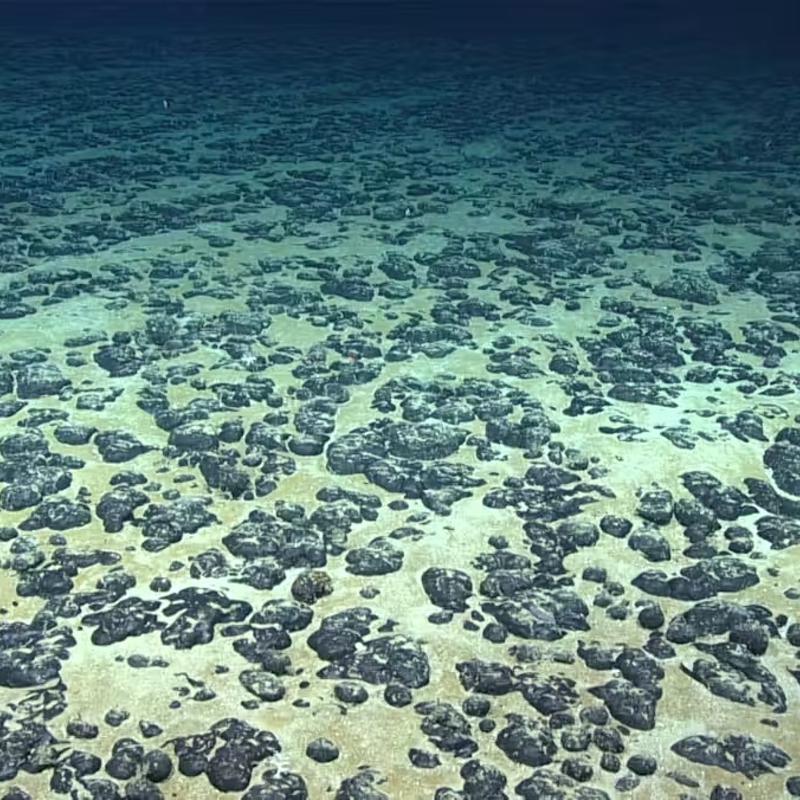
In a quirk of nature, fist-sized rocks called polymetallic nodules are scattered across millions of square kilometres of the seabed in all five of the world’s oceans. These nodules formed over millions of years, as metal ions dissolved in sea water and collected around a tiny nucleus such as a shell fragment or a shark’s tooth.

Concealed in the nodules are nickel, copper, cobalt, manganese and rare earth elements. The metals are critical for the artificial intelligence sector and national defence — think of drones and bombs and fighter jets — as well as for the necessities of modern-day life, such as cellphones and laptops. They’re also needed for the long-promised, yet still elusive, energy transition to wean the world off fossil fuels. Copper is used to make solar panels and wind turbines, while electric vehicle batteries require cobalt, nickel and manganese.

The nodules are especially plentiful in a relatively flat area of the international seabed between Mexico and Hawaii known as the Clarion-Clipperton zone. It’s here that the Metals Co., with the backing of the Trump administration, plans to mine.

“It’s almost unbelievable good fortune that you would have the planet’s largest source of nickel, copper, cobalt and manganese all sitting in one relatively small area,” Usher told The Tyee.

While the company initially plans to mine a 65,000-square-kilometre area, Usher pointed out that it’s only a small fraction of the global sea floor. “It’s not big relative to other oceans,” he said.


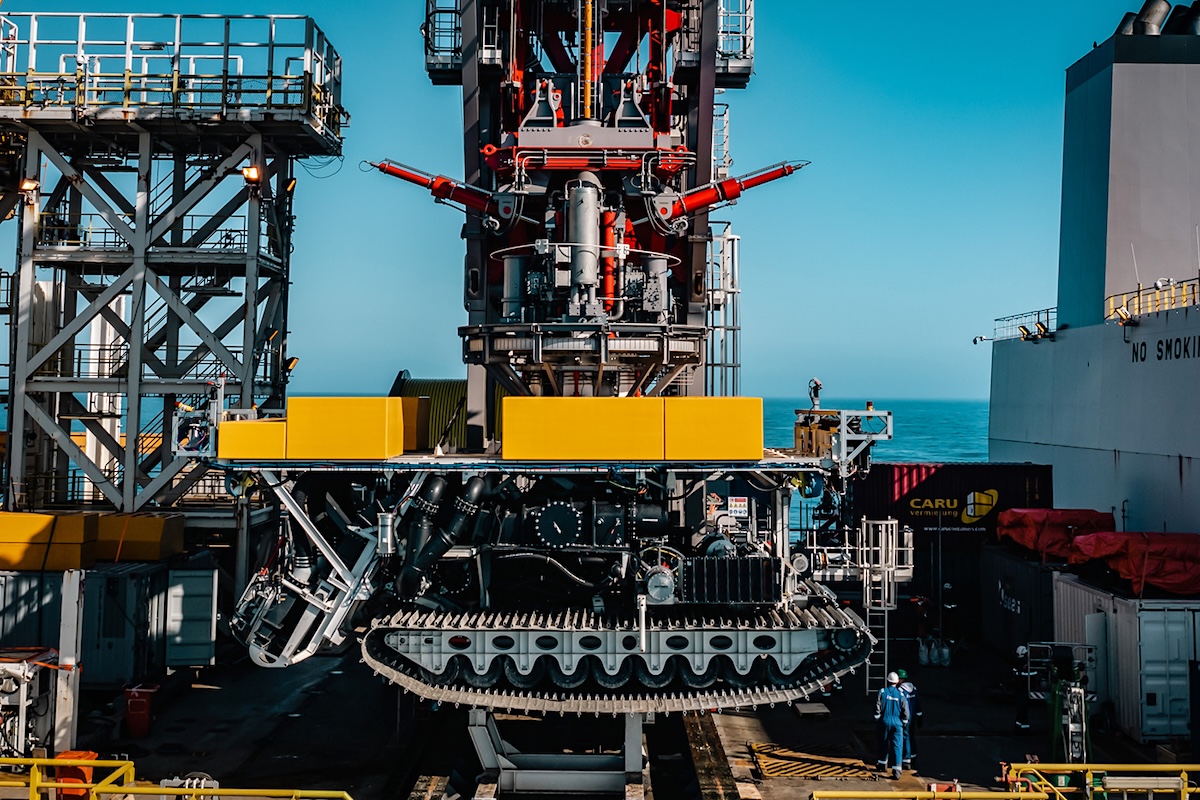
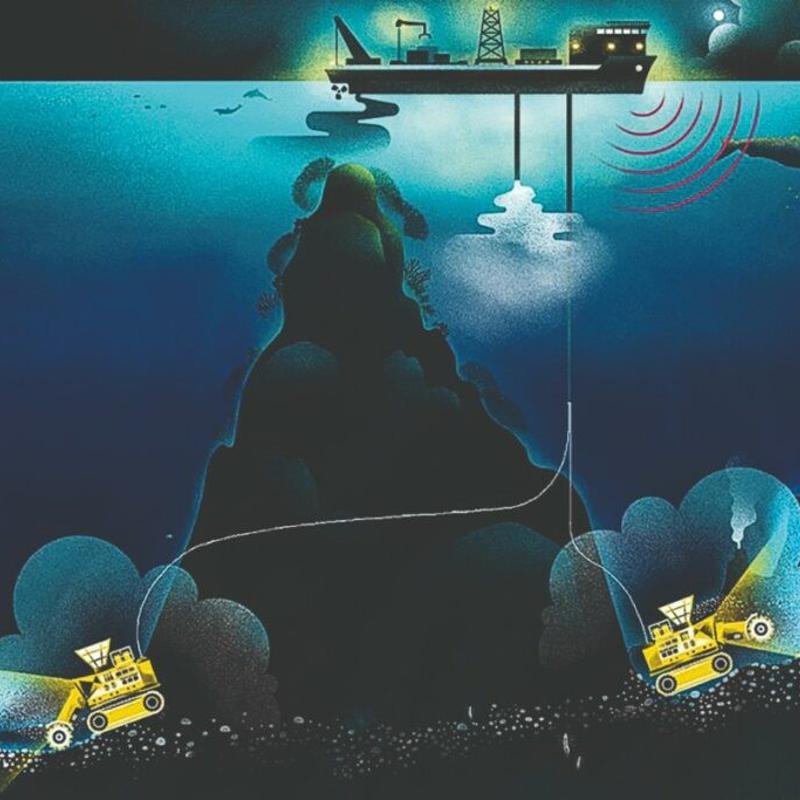
To gather the nodules, the Metals Co. plans to lower a remotely operated collector vehicle the size of a bus about four kilometres to the seabed floor. The robotic vehicle, which has wide treads for crawling along the ocean floor, will be attached to a mother ship at the surface by an umbilical cord-like pipe.

As the machine advances, it will blast sea water at the nodules to loosen them and then vacuum them up into a hopper. Pumps inside the hopper will separate the nodules from sediment, discharging the sediment back into the sea. Air pumped down a pipe called a riser will equalize the pressure, and the nodules will shoot up to the mother ship, where a centrifuge will separate them from the remaining sea water and a conveyor belt will deposit them into the ship’s hold.

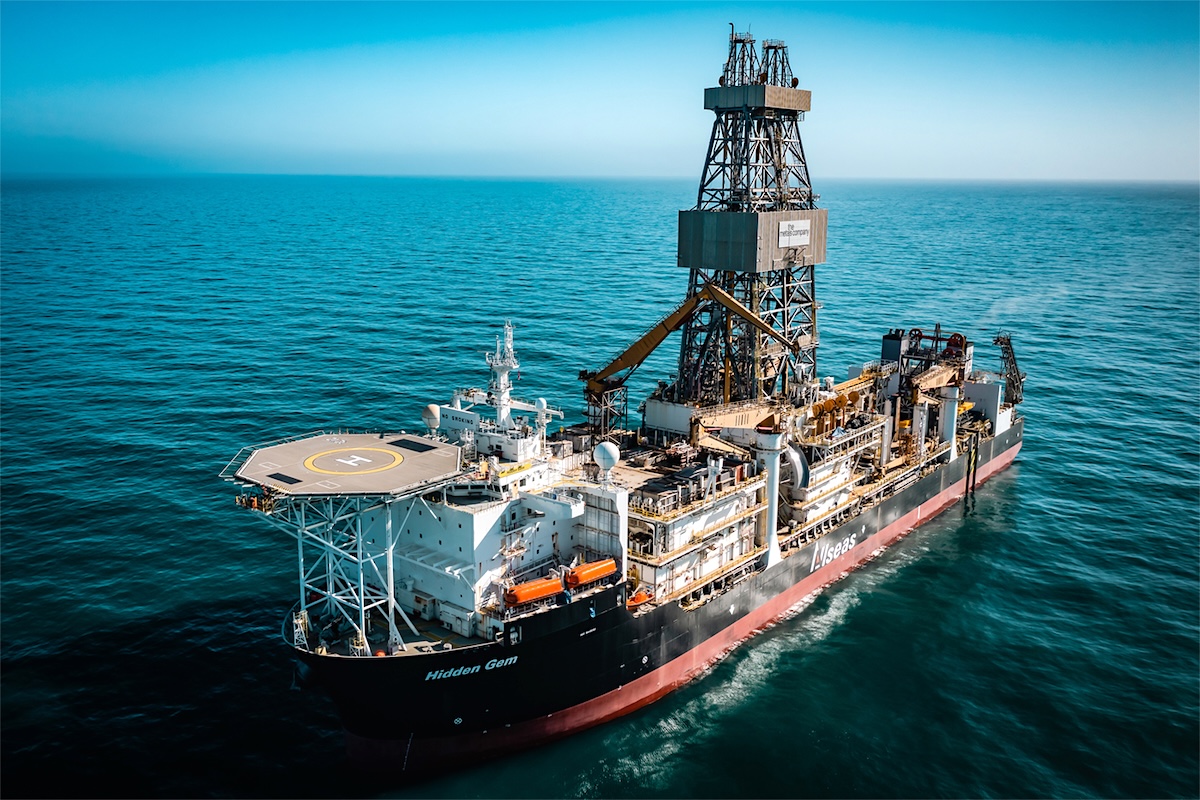
The Metals Co. transformed a drill ship from the offshore oil and gas industry into a nodule collection vessel it has named the Hidden Gem. On a trial run in the fall of 2022, the Hidden Gem collected more than 3,000 tonnes of nodules.

To put that into perspective, a single tonne of nodules from the Clarion-Clipperton zone yields about 13 kilograms of nickel, 11 kilograms of copper, 284 kilograms of manganese and two kilograms of cobalt.

A typical electric vehicle requires about 40 kilograms of nickel and 50 kilograms of copper, while a modern fighter jet needs about 100 to 400 kilograms of copper for wiring and electronics.

Why not to mine the deep sea

Usher argues that the world will quickly need more metals, and mining the deep sea will have fewer environmental impacts than mining on land.

“There’s no free lunch,” he told The Tyee. “There are impacts in the deep sea, and there are impacts for terrestrial mining ecosystems. The question is which of those choices — that we must make, obviously — presents the lightest possible impact.”

He pointed to mining in Indonesia, which accounts for about 60 per cent of the world’s nickel production. Nickel mines have destroyed large tracts of Indonesian rainforest, including in biodiversity hot spots, and runoff is contaminating coral reefs and destroying coastal marine ecosystems.

It makes sense, Usher said, to source metals “from the part of the planet where there is the least life, not the most.” The area where the Metals Co. plans to mine has “no humans... no birds... no trees,” he said.The Metals Co. transformed a drill ship from the offshore oil and gas industry into a nodule collection vessel it has named the Hidden Gem. Photo via the Metals Co.

In one of Barron’s short social media videos, which was viewed by The Tyee but has since been deleted, he stood on a barren, windswept lava field in Iceland, framed by sombre grey skies. “As you can see, there are no plants, there are no animals moving about,” Barron told viewers. “It’s a pretty lifeless area,” he added, comparing it to the Clarion-Clipperton zone.

There’s just one problem: the deep sea is one of the world’s most vital carbon sinks, and it’s teeming with life. It just looks a little different than life on land.

The deep sea is home to fantastical creatures that produce their own light, consume bacteria and thrive in pressures that can crush a car. The world’s deepest-living octopus makes its home in areas that could eventually be slated for deep-sea mining, including in the Clarion-Clipperton zone. Named after the cartoon elephant that uses its oversized ears to fly, the small Dumbo octopus swims by flapping prominent fins on each side of its head.

Colourful sea cucumbers, graceful jellyfish, tiny anemones, yellow sea lilies and slow-growing sponges all live near the nodules. One newly discovered sea creature called Relicanthus sp. — it looks like an ivory kite flying through the ocean with a profusion of stringlike tails — lives on sponge stalks attached to nodules in the Clarion-Clipperton zone. A 2023 study detailed more than 5,000 species new to science in the Clarion-Clipperton zone.

The Metals Co., which has carried out publicly available environmental studies of deep-sea mining, says deep-sea mining will create fewer carbon emissions than land-based mining and that plumes from disturbed sediment will be localized. The company also says it plans to leave behind nodules to provide habitats for organisms to recolonize areas after mining.

Yet more than 1,000 marine scientists and policy experts worldwide have signed a science statement outlining concerns about deep-sea mining and pointing out that its impacts on biodiversity, ecosystems and human well-being are not yet understood.

The Deep Ocean Stewardship Initiative, a network of global experts in fields such as science, technology and economics, says that nodule fields are an important deep-sea ecosystem that hosts a diversity of life and directly benefits humans by helping to regulate the climate.

Studies have also found that deep-sea mining could threaten commercial fisheries. And a 2025 study found that sediment plumes and other impacts from deep-sea mining could threaten at least 30 species of sharks, chimeras and rays, many already at risk of extinction.‘We all have a stake in the ocean,’ says Rashid Sumaila, an economist who teaches at the University of British Columbia’s Institute for the Ocean and Fisheries. Photo by Martin Dee.

“If you want a regenerative blue economy, then deep-sea mining is not part of it,” Rashid Sumaila, an economist who teaches at the University of British Columbia’s Institute for the Oceans and Fisheries, told The Tyee.

Sumaila and other researchers have concluded that deep-sea mining poses significant environmental, social and economic risks that could have far-reaching consequences for coastal communities and small island developing states. They also found that deep-sea mining is likely to negatively affect the business community, including insurers and investors.

Sumaila points to the tuna industry, noting that the Clarion-Clipperton zone is one of the richest tuna fishing areas in the world. Deep-sea mining, he said, can potentially disrupt tuna habitats and alter migration patterns by creating sediment plumes, generating noise and light pollution and discharging water with higher concentrations of metals.

“Fish don’t need visas,” he said — and the tuna make their way to Canada, where they are caught commercially. “We all have a stake in the ocean,” Sumaila said.

Instead of increasing the world’s supply of critical minerals, Sumaila said, we should be looking at how to reduce our need for them.

“If we just go, ‘Oh we need more, we need more,’ where are you going to stop?” he asks. “This shouldn’t be a question of only supply; it should be a question of demand.”

Trump’s plans called ‘unlawful and illegal’

Under the United Nations Convention on the Law of the Sea — ratified by 171 countries and the European Union — an agency called the International Seabed Authority is responsible for managing mineral resources in the deep ocean floor beyond areas of national jurisdiction.

The authority, which is headquartered in Jamaica, has spent more than 10 years hashing out rules for seabed mining, including environmental and liability regulations.

Over the years, the authority has granted the Metals Co. and 20 other contractors a total of 31 exploration leases worldwide, including in the Clarion-Clipperton zone. The Metals Co. partnered with the tiny Pacific Island countries of Nauru and Tonga, where it has subsidiaries, to secure its seabed authority exploration contracts.The Metals Co. plans to lower a remotely operated collector vehicle about four kilometres to the seabed floor. The robotic vehicle will be attached to the Hidden Gem by an umbilical cord-like pipe. Photo via the Metals Co.

The company’s permit applications to the U.S. government substantially overlap with its exploration licences from the seabed authority. The company has conducted its research in the seabed authority exploration areas, and its 2022 nodule collection also took place in the area overseen by the authority.

Barron said he turned to the Trump administration last year because the seabed authority was taking too long to finalize deep-sea mining rules for commercial extraction and failed to meet its own deadlines.

“I depend on shareholder support,” Barron told Ryan, the podcast and YouTube talk show host, “and unfortunately shareholders would not have been willing to give me another five years to sit around and see what happens.”

Yet, as the Metals Co.’s U.S. subsidiary pursues unilateral mining, the company’s Nauru and Tonga subsidiaries have maintained their seabed authority exploration contracts. The seabed authority has now launched an investigation into their actions.

Trump’s plans to push ahead with unilateral mining in areas under the seabed authority’s jurisdiction have rankled countries around the world, including China, France and Russia.

France’s special envoy to the seabed authority says the United States is violating the principle of non-appropriation of the high seas and weakening the framework of the international law of the sea “to the detriment of all.” International Seabed Authority president Leticia Carvalho told Australian broadcaster ABC that the Trump government’s decision to issue permits is “unlawful and illegal and challenges the rule of law and the unilateral order.”

While the United States hasn’t ratified the international law of the sea convention, it has accepted most of its provisions, including freedom of navigation and the ability to fish in international waters, as customary international law.


Mining Firms May Soon Bypass UN Rules and Mine the Deep Searead more

Where Canada could, or should, come in

Seck, the Dalhousie law professor whose research focuses on the mining sector and ocean law, told The Tyee that there are good reasons to believe the Metals Co.’s applications to the U.S. administration violate international law.

And specific provisions in the law of the sea convention suggest that Canada “does have an obligation to make sure that they are in no way supporting this company... and in no way enabling illegal activity,” she said.

Yet both Seck and Neil Craik, a law professor at the University of Waterloo with expertise in deep-sea mining, say the situation is complex because the applications to the U.S. government for deep-sea mining were made by the U.S. subsidiary of the Metals Co.

Craik said the Carney government, “at a minimum,” should be asking questions about the relationship between the Metals Co. and its U.S. subsidiary.

Is the subsidiary independent, or “is the Canadian parent, in some ways, a directing mind of the company?” asks Craik, whose work focuses on environmental regulation and liabilities for deep-sea mining in areas beyond national jurisdiction.

If the U.S. subsidiary is relying on data and technology developed by the Canadian parent company, Craik said, the two may be acting as a cohesive enterprise and “Canada may have positive obligations to ensure that that company is acting in accordance with international law.”

Global Affairs Canada did not respond directly to The Tyee’s questions about the Metals Co. and international law.

Instead, media relations spokesperson John Babcock said Canada is aware of recent developments related to seabed mining applications and “continues to engage constructively with partners on the issue of deep seabed mining in areas beyond national jurisdiction.”

Babcock said Canada, as a general practice, does not comment on the corporate structure or operations of specific companies, adding that Canadian companies operating internationally are “expected to comply with applicable laws and align with international standards and best practices.”


The Fight Over Seabed Mining Comes to Vancouverread more

He said Canada is actively participating at the International Seabed Authority “to advance negotiations and support the timely development of commercialization regulation” for deep-sea mining. During the seabed authority’s March 2026 meeting, Canada contributed to discussions aimed at ensuring strong environmental protections are embedded in the regulatory framework, Babcock noted.

Canada takes its obligations at the seabed authority seriously and continues to advocate for a “robust, science-based regulatory regime that includes strong environmental protections, transparency and accountability,” Babcock said, adding that Canada will continue to monitor developments closely.

He also confirmed that Canada still supports a moratorium on deep-sea mining, which is welcome news for Mining Watch Canada and other organizations.

“This is an ecosystem that cannot be mined in any way responsibly, and we’re better off sticking to mining on land and trying to do that responsibly, rather than to destroy another entire area,” Coumans said.


Read more: Politics, Environment

Independent journalism thrives when readers choose to support it

Nearly every week, I see newspapers and magazines that seemed fine suddenly going out of business. Or a private equity fund buying up a chain of newspapers that had been serving communities for decades and stripping them for parts. And now, the thing that’s making all publishers wring their hands is AI – publishers are seeing massive drops to their web visits as AI scrapes their content and delivers it up to people in chatbots, with the journalists who did the original work not even credited with the work.

Despite this, I have hope for journalism because of what’s happening at The Tyee.

Years ago, we made a strategic bet that support from our readers was going to drive our whole future. And thankfully, that is working for us.

Over the past decade, we’ve more than doubled our journalism team and are publishing more work than ever. More people read The Tyee now than at any point in our 23-year history.

This is only possible because we regularly ask our readers to sign up as paying Tyee Builder members. Roughly half of our entire budget is made up of contributions from over 10,000 readers.

We’ve been doing more as our resources have grown. A weekend culture section filled with original essays. Hard-hitting investigative journalism in Alberta. A brand new biodiversity beat. A reporting project called Reality Check, focusing on misinformation and online radicalization. A flagship podcast.

Our model is simple: if more of our readers sign up to support The Tyee, we can keep up with rising costs and keep adding more talented journalists to our roster and set them loose on uncovering truths that would otherwise not see the light of day.

Please help us prove that Independent Journalism Thrives with reader support.


— Jeanette Ageson, PublisherSupport us now

RG Richardson Communications News

I am a business economist with interests in international trade worldwide through politics, money and banking. Interactive Internet VoIP and secure eMail Communications. The author of RG Richardson City Guides that has over 300 guides, including restaurants, real estate and finance.