RG Richardson Business & Economics

RG Richardson Business & Economics
Interactive financial ebooks

Japanese Airport Trialing Humanoid Robots as Baggage Handlers

 Japanese Airport Trialing Humanoid Robots as Baggage Handlers

Japanese Airport Trialing Humanoid Robots as Baggage Handlers

No pressure, since they'll be working at one of the busiest airports in the world.
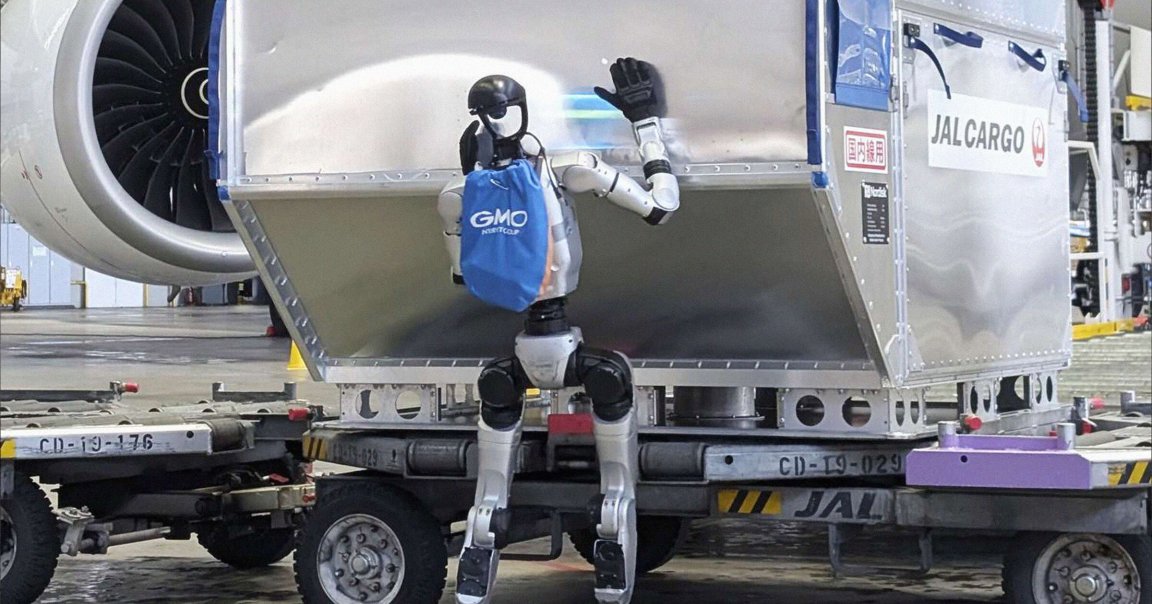
A humanoid robot is shown unloading a jet at an airport.
Kyodo News / Getty Images

The future is truly upon us — because the next time your check-in luggage gets battered, you could be blaming a robot.

Starting in May, Japan Airlines, in partnership with GMO AI & Robotics, will start trialing humanoid robots to help baggage handlers at Tokyo’s Haneda airport, it announced Monday, in the hopes that they could one day alleviate a labor shortage.

In a demonstration held in front of the media, one of the mechanical helpers built by the Chinese Robotics company Unitree gently pushes — or should we say barely touches — a metal container stacked with suitcases towards a passenger jet. Its contribution is entirely perfunctory, though, since the container is actually being moved by a conveyor belt; the robot didn’t “help” with anything at all.

Not that the robot’s aware. Oblivious, the Unitree machine proudly waves to his human colleague controlling the belt, who kindly returns a thumbs-up.

The stunt is clearly not a serious demonstration of the robots’ capabilities — if it does have meaningful capabilities at all — but Japan Airlines certainly sounds serious about the experiment, since it’s planning for it to run until 2028. 

It will be a trial by fire for the androids. Serving more than 60 million passengers per year, Haneda is easily one of the busiest air travel hubs in the world. Slip-ups could lead to luggage being lost or damaged, or costly delays.

They’ll also face steep competition. We’re not trying to launder Japan’s PR any more than it already gets, but its baggage handlers are pretty lauded for being thorough and gentle, and going above and beyond. That’s kind of remarkable, since the only other time baggage handlers make the news is for piling together your fragile belongings like sandbags.

How capable the bots prove remains to be seen. It could go horribly wrong, given the number of robot flameouts we’ve witnessed. But in theory they’ll help Japan’s baggage handlers deal with the influx of tourists, seven million of whom visited in the first two months of this year alone.

“While airports appear highly automated and standardised, their back-end operations still rely heavily on human labour and face serious labour shortages,” GMO AI & Robotics’ president Tomohiro Uchida told reporters, per the BBC.

Eric Trump's Crypto Company Is Falling Into Total Disaster

 Eric Trump's Crypto Company Is Falling Into Total Disaster

Eric Trump’s Crypto Company Is Falling Into Total Disaster

The grift is in danger.
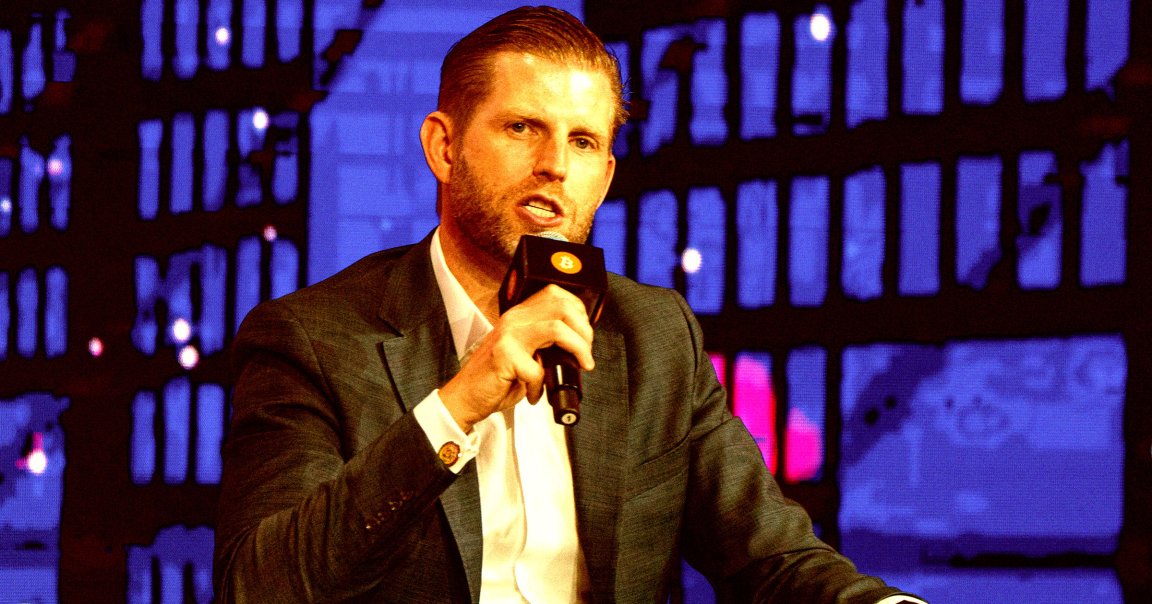
A shady crypto company quietly scrubbed Eric Trump's name from its public leadership following major legal and financial turmoil.
VERNON YUEN/AFP via Getty Images

President Donald Trump and his spawn have reaped billions of dollars worth of crypto during his second term in office, a highly questionable portfolio considering his ability to regulate the very market that’s made him obscenely rich.

But the Trump crypto empire isn’t looking nearly as hot these days. A shady Las Vegas-based financial firm called Alt5 Sigma Corp, which has been stockpiling tokens from the Trump family’s World Liberty Financial venture, has quietly scrubbed Eric Trump’s name from its public leadership following major legal and financial turmoil, as the Daily Beast reports.

The news comes after major World Liberty Financial investor and crypto billionaire Justin Sun filed a lawsuit against the company earlier this month, accusing it of illegally freezing his tokens and profiting off fraud. (Eric Trump downplayed Sun’s legal threat as “ridiculous.”)

The lawsuit couldn’t have come at a worse time for Alt5. Since it announced it was stockpiling World Liberty tokens in August, its shares have lost around 90 percent of their value, trading at a measly 74 cents at press time.

The president’s son was originally envisioned to become a board director of Alt5, but was quickly downgraded to “board observer,” a far more hands-off role.

To call Alt5 a car wreck of a company would be a vast understatement. The company of just 16 employees burned through a staggering $341 million in its latest fiscal year, warning investors it had “substantial doubts” about its ability to keep going for another year, per the Beast.

Before its questionable crypto deal, it was an appliance recycling business, which then pivoted to biotech, and eventually fintech.

Several former executives have been found “criminally liable for offenses including illicit enrichment and money laundering” in Rwanda last year, according to 2025 Securities and Exchange Commission filings. Alt5 has also cycled through three CEOs in just six weeks late last year.

The decision to scrub Eric Trump from its leadership highlights only the latest highly questionable crypto venture tied to the Trump clan. Donald Trump’s crypto token, $TRUMP, which launched ahead of his second inauguration in January last year, has turned out to be a spectacular failure. Its value has lost a staggering percentage of its value over the last year, circling the drain at just over $2.30.

Trump’s disastrous Truth Social company, Trump Media & Technology Group, which similarly stockpiled a Bitcoin reserve, has seen its shares plummet to record lows earlier this year amid hundreds of millions in losses.

Last month, even CEO Devin Nunes, a longtime Trump loyalist and advisor, saw the writing on the wall, and ended up walking away.

War threatens Russian banking crisis

War threatens Russian banking crisis, European intelligence report says
By John Irish and John O'DonnellJuly 6, 20265:45 AM PDT Updated 4 hours ago


A flag flies above the headquarters of the Russian Central Bank on the day of a key rate-setting meeting in Moscow, Russia, April 24, 2026. REUTERS/Anastasia Barashkova Purchase Licensing Rights, opens new tab
Summary
Companies
Intelligence report by European country outlines risk to Russia's banks
Report comes ahead of fresh EU sanctions
Report says banks are propping up Russia's economy, creating an 'illusion' which 'conceals explosive situation'
Russia's central bank has said it has no 'critical vulnerabilities'
PARIS/BERLIN, July 6 (Reuters) - Russia risks an "explosive" banking crisis because lenders are shouldering much of the burden of the country's war economy, a European state intelligence report seen ​by Reuters has warned, as the European Union readies a raft of new sanctions.
The two-page document, which was prepared in recent weeks to inform European officials about the state ‌of Russia's banks, outlines their vulnerability to further Western curbs.

While Russia's banks have mostly weathered the sanctions imposed since Moscow's 2022 full-scale invasion of Ukraine, the June report says deteriorating loans and growing household indebtedness create an "explosive" risk, just as the EU prepares a 21st package of sanctions it hopes to finalise in July, targeting banks and cryptocurrency networks.
The Russian central bank declined to comment on the assessment, although it has recently played down the risks of a major banking crisis.
With the ​cost of a four-year war with Ukraine draining state coffers, Russia has increasingly leant on banks to support companies and borrowers. The report says this has lumbered banks with risks, as ​the economy teeters.

The Economy Ministry cut its gross domestic product growth forecast to 0.4% in 2026 from 1.3% previously and to 1.4% in 2027 from 2.8%.
The intelligence ⁠report, titled "Note on the probability of a banking crisis in Russia in 2026", said banks have been pushed to give subsidised loans to defence companies, homebuyers and others. It noted that state-backed credit ​programmes, loan restructurings and government support masked the banks' vulnerability.
"The situation creates the illusion of a dynamic economy that, in reality, conceals an explosive situation which an economic shock, such as an ambitious package of ​sanctions against banks ... could trigger," said the report.
Lending to defence firms, regional state-backed projects and homeowners has increased the amount of loans that may never be repaid, the authors said.

01:10Microsoft joins AI-driven tech layoff wave with 4,800 job cutsSkip in 4s

The report estimates that 10% of corporate loans are doubtful, a sharp increase from 2024, while some major banks reported retail non-performing loan ratios as high as 15% in 2025.
It also says that more than 500,000 Russians declared bankruptcy in 2025, up almost a third from the previous year, while ​state programmes encouraged more than 13 million Russians to take out at least three loans simultaneously.
Russian central bank Deputy Governor Filipp Gabunia said last month that "vulnerabilities in the financial sector are not critical," stressing ​that banks' capital cushion was at the highest level in three years, while corporate bad loans had, at 4%, not changed during the last year and a half.
"Russia's economy is stagnating but the dominance of the state and ‌defence spending means ⁠there is no immediate financial crisis to hand," said Chris Weafer, a Russia expert at consultancy Macro Advisory.
Advertisement · Scroll to continue


"Asia ignores sanctions. So the idea that a fresh round will tip Russia into crisis is wishful thinking," he said, adding that defence spending was keeping unemployment low and wages high.
RUSSIA HAS PROVEN RESILIENT, DESPITE SANCTIONS
The European Union has imposed sweeping sanctions on Russia in an attempt to choke bank profits and international money movements, oil and gas sales and the defence sector.
Russia has struggled but proven largely resilient, while Europe has often had difficulty enforcing sanctions, with no central authority to do so.

Compounding Europe's difficulties, the United ​States, under President Donald Trump, has loosened some sanctions, ​earlier granting temporary permission to sell Russian oil, ⁠although that waiver expired in mid-June.
European diplomats are now discussing targeting banks and cryptocurrency networks as well as drone production, oil traders and refiners.
This would add scores of individuals and entities to the sanctions list, including nearly 90 banks, bringing the number of blackballed lenders to more than 100 — over half of the ​country's internationally connected banks.
SBERBANK EXECUTIVE — EVERYONE USED TO SANCTIONS
Russian President Vladimir Putin recently said Russia would press ahead with its battlefield aim of fully ​capturing four Ukrainian regions, despite ⁠the sanctions, rejecting what he said was a new proposal by Ukraine to rein in hostilities.
Putin also said Russia was expecting a resumption of U.S.-led diplomatic efforts to end the war, once the "hot phase" of the U.S.-Israeli conflict with Iran was resolved.
There are signs of increasing pressure. Russia's second-largest lender VTB plans to boost reserves, its first deputy CEO told Reuters on Friday, to shield itself against higher fuel prices and possible loan losses.
The ⁠amount of cash ​being held outside banks has grown by more than 17% year-on-year to over 19 trillion roubles ($243 billion) so far this ​year, according to central bank data.
That has put pressure on banks which rely on deposits to fund lending.
"All major banks are already under sanctions ... and when they were introduced in 2022, there was stress," Taras Skvortsov, chief financial officer of Russia's largest bank, ​Sberbank, told Reuters.
"By 2026, everyone has become so used to it. Many clients of the sanctioned banks do not even know about sanctions."


Writing by John O'Donnell; editing by Elisa Martinuzzi, Elaine Hardcastle and Sharon Singleton

Our Standards: The Thomson Reuters Trust Principles., opens new tabSuggested Topics:


What’s happening to offshore racing?

 What’s happening to offshore racing?

Yacht Racing Performance Coach Stuart Greenfield launches into the first part of a three part series about what’s happening to offshore racing:


The idea for this series began, as many useful offshore conversations do, in the dark.

This year I was skippering a Sun Fast 3600 in the RORC Myth of Malham with a crew of mixed experience. Some were good sailors, some were still finding their way, and most were new to the particular rhythm of offshore racing: the watches, the damp kit, the strange meals, the long quiet spells, the sudden urgency, and the way a boat becomes its own small moving world once the land has disappeared astern.

By the first night, once the boat had settled, the sails were trimmed, the watch system was working and the first nervousness had gone, the conversation moved beyond the race itself.

How did this sport begin?

Why did anyone think it was a good idea to race yachts offshore, through tide, darkness, poor weather and all the uncertainty of the sea?

And, perhaps most honestly, was offshore racing always just a rich person’s ego sport, and is it still one now?

It is a fair question. – Full report

Supreme Court says SEC can recoup ill-gotten gains in fraud cases | AP News

Supreme Court says SEC can recoup ill-gotten gains in fraud cases | AP News

Supreme Court upholds broad reading of SEC authority to recoup ill-gotten gains in fraud cases


By MARK SHERMAN
Updated 8:04 AM GMT-7, June 4, 2026

WASHINGTON (AP) — The Supreme Court on Thursday upheld a broad reading of the authority of the Securities and Exchange Commission to recoup ill-gotten gains from people who engage in securities fraud.

The justices ruled unanimously against Ongkaruck Sripetch, who was sentenced to 21 months in prison after pleading guilty to selling unregistered securities as part of a scheme involving high-risk penny stocks. The Los Angeles resident had challenged a court order of disgorgement, to repay more than $3 million, including interest.

The issue in the case was whether the SEC had to prove that individual investors lost money as a result of buying the stocks. The Supreme Court ruled it did not.

It was enough to show that Sriptech turned a profit from illegal transactions and that “an investor may qualify as a victim of an offender’s wrongdoing entitled to compensation,” Justice Neil Gorsuch wrote for the court.

Sripetch took part in fraudulent schemes involving at least 20 penny stock companies, Gorsuch wrote, citing court records. Some of those were “pump and dump” operations, in which Sripetch and others bought stocks, promoted them so that their share price rose and then promptly sold them, Gorsuch wrote.

RG Richardson Communications News

I am a business economist with interests in international trade worldwide through politics, money and banking. Interactive Internet VoIP and secure eMail Communications. The author of RG Richardson City Guides has over 300 guides, including restaurants and finance.