RG Richardson Business & Economics

RG Richardson Business & Economics
Interactive financial ebooks

Eric Trump's Crypto Company Is Falling Into Total Disaster

 Eric Trump's Crypto Company Is Falling Into Total Disaster

Eric Trump’s Crypto Company Is Falling Into Total Disaster

The grift is in danger.
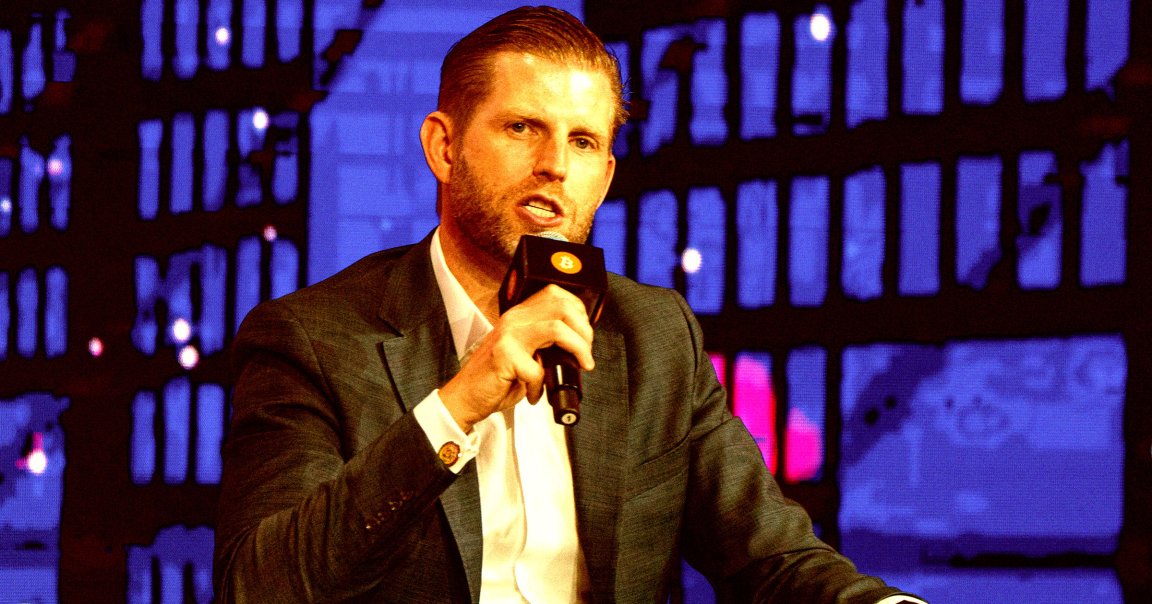
A shady crypto company quietly scrubbed Eric Trump's name from its public leadership following major legal and financial turmoil.
VERNON YUEN/AFP via Getty Images

President Donald Trump and his spawn have reaped billions of dollars worth of crypto during his second term in office, a highly questionable portfolio considering his ability to regulate the very market that’s made him obscenely rich.

But the Trump crypto empire isn’t looking nearly as hot these days. A shady Las Vegas-based financial firm called Alt5 Sigma Corp, which has been stockpiling tokens from the Trump family’s World Liberty Financial venture, has quietly scrubbed Eric Trump’s name from its public leadership following major legal and financial turmoil, as the Daily Beast reports.

The news comes after major World Liberty Financial investor and crypto billionaire Justin Sun filed a lawsuit against the company earlier this month, accusing it of illegally freezing his tokens and profiting off fraud. (Eric Trump downplayed Sun’s legal threat as “ridiculous.”)

The lawsuit couldn’t have come at a worse time for Alt5. Since it announced it was stockpiling World Liberty tokens in August, its shares have lost around 90 percent of their value, trading at a measly 74 cents at press time.

The president’s son was originally envisioned to become a board director of Alt5, but was quickly downgraded to “board observer,” a far more hands-off role.

To call Alt5 a car wreck of a company would be a vast understatement. The company of just 16 employees burned through a staggering $341 million in its latest fiscal year, warning investors it had “substantial doubts” about its ability to keep going for another year, per the Beast.

Before its questionable crypto deal, it was an appliance recycling business, which then pivoted to biotech, and eventually fintech.

Several former executives have been found “criminally liable for offenses including illicit enrichment and money laundering” in Rwanda last year, according to 2025 Securities and Exchange Commission filings. Alt5 has also cycled through three CEOs in just six weeks late last year.

The decision to scrub Eric Trump from its leadership highlights only the latest highly questionable crypto venture tied to the Trump clan. Donald Trump’s crypto token, $TRUMP, which launched ahead of his second inauguration in January last year, has turned out to be a spectacular failure. Its value has lost a staggering percentage of its value over the last year, circling the drain at just over $2.30.

Trump’s disastrous Truth Social company, Trump Media & Technology Group, which similarly stockpiled a Bitcoin reserve, has seen its shares plummet to record lows earlier this year amid hundreds of millions in losses.

Last month, even CEO Devin Nunes, a longtime Trump loyalist and advisor, saw the writing on the wall, and ended up walking away.

War threatens Russian banking crisis

War threatens Russian banking crisis, European intelligence report says
By John Irish and John O'DonnellJuly 6, 20265:45 AM PDT Updated 4 hours ago


A flag flies above the headquarters of the Russian Central Bank on the day of a key rate-setting meeting in Moscow, Russia, April 24, 2026. REUTERS/Anastasia Barashkova Purchase Licensing Rights, opens new tab
Summary
Companies
Intelligence report by European country outlines risk to Russia's banks
Report comes ahead of fresh EU sanctions
Report says banks are propping up Russia's economy, creating an 'illusion' which 'conceals explosive situation'
Russia's central bank has said it has no 'critical vulnerabilities'
PARIS/BERLIN, July 6 (Reuters) - Russia risks an "explosive" banking crisis because lenders are shouldering much of the burden of the country's war economy, a European state intelligence report seen ​by Reuters has warned, as the European Union readies a raft of new sanctions.
The two-page document, which was prepared in recent weeks to inform European officials about the state ‌of Russia's banks, outlines their vulnerability to further Western curbs.

While Russia's banks have mostly weathered the sanctions imposed since Moscow's 2022 full-scale invasion of Ukraine, the June report says deteriorating loans and growing household indebtedness create an "explosive" risk, just as the EU prepares a 21st package of sanctions it hopes to finalise in July, targeting banks and cryptocurrency networks.
The Russian central bank declined to comment on the assessment, although it has recently played down the risks of a major banking crisis.
With the ​cost of a four-year war with Ukraine draining state coffers, Russia has increasingly leant on banks to support companies and borrowers. The report says this has lumbered banks with risks, as ​the economy teeters.

The Economy Ministry cut its gross domestic product growth forecast to 0.4% in 2026 from 1.3% previously and to 1.4% in 2027 from 2.8%.
The intelligence ⁠report, titled "Note on the probability of a banking crisis in Russia in 2026", said banks have been pushed to give subsidised loans to defence companies, homebuyers and others. It noted that state-backed credit ​programmes, loan restructurings and government support masked the banks' vulnerability.
"The situation creates the illusion of a dynamic economy that, in reality, conceals an explosive situation which an economic shock, such as an ambitious package of ​sanctions against banks ... could trigger," said the report.
Lending to defence firms, regional state-backed projects and homeowners has increased the amount of loans that may never be repaid, the authors said.

01:10Microsoft joins AI-driven tech layoff wave with 4,800 job cutsSkip in 4s

The report estimates that 10% of corporate loans are doubtful, a sharp increase from 2024, while some major banks reported retail non-performing loan ratios as high as 15% in 2025.
It also says that more than 500,000 Russians declared bankruptcy in 2025, up almost a third from the previous year, while ​state programmes encouraged more than 13 million Russians to take out at least three loans simultaneously.
Russian central bank Deputy Governor Filipp Gabunia said last month that "vulnerabilities in the financial sector are not critical," stressing ​that banks' capital cushion was at the highest level in three years, while corporate bad loans had, at 4%, not changed during the last year and a half.
"Russia's economy is stagnating but the dominance of the state and ‌defence spending means ⁠there is no immediate financial crisis to hand," said Chris Weafer, a Russia expert at consultancy Macro Advisory.
Advertisement · Scroll to continue


"Asia ignores sanctions. So the idea that a fresh round will tip Russia into crisis is wishful thinking," he said, adding that defence spending was keeping unemployment low and wages high.
RUSSIA HAS PROVEN RESILIENT, DESPITE SANCTIONS
The European Union has imposed sweeping sanctions on Russia in an attempt to choke bank profits and international money movements, oil and gas sales and the defence sector.
Russia has struggled but proven largely resilient, while Europe has often had difficulty enforcing sanctions, with no central authority to do so.

Compounding Europe's difficulties, the United ​States, under President Donald Trump, has loosened some sanctions, ​earlier granting temporary permission to sell Russian oil, ⁠although that waiver expired in mid-June.
European diplomats are now discussing targeting banks and cryptocurrency networks as well as drone production, oil traders and refiners.
This would add scores of individuals and entities to the sanctions list, including nearly 90 banks, bringing the number of blackballed lenders to more than 100 — over half of the ​country's internationally connected banks.
SBERBANK EXECUTIVE — EVERYONE USED TO SANCTIONS
Russian President Vladimir Putin recently said Russia would press ahead with its battlefield aim of fully ​capturing four Ukrainian regions, despite ⁠the sanctions, rejecting what he said was a new proposal by Ukraine to rein in hostilities.
Putin also said Russia was expecting a resumption of U.S.-led diplomatic efforts to end the war, once the "hot phase" of the U.S.-Israeli conflict with Iran was resolved.
There are signs of increasing pressure. Russia's second-largest lender VTB plans to boost reserves, its first deputy CEO told Reuters on Friday, to shield itself against higher fuel prices and possible loan losses.
The ⁠amount of cash ​being held outside banks has grown by more than 17% year-on-year to over 19 trillion roubles ($243 billion) so far this ​year, according to central bank data.
That has put pressure on banks which rely on deposits to fund lending.
"All major banks are already under sanctions ... and when they were introduced in 2022, there was stress," Taras Skvortsov, chief financial officer of Russia's largest bank, ​Sberbank, told Reuters.
"By 2026, everyone has become so used to it. Many clients of the sanctioned banks do not even know about sanctions."


Writing by John O'Donnell; editing by Elisa Martinuzzi, Elaine Hardcastle and Sharon Singleton

Our Standards: The Thomson Reuters Trust Principles., opens new tabSuggested Topics:


What’s happening to offshore racing?

 What’s happening to offshore racing?

Yacht Racing Performance Coach Stuart Greenfield launches into the first part of a three part series about what’s happening to offshore racing:


The idea for this series began, as many useful offshore conversations do, in the dark.

This year I was skippering a Sun Fast 3600 in the RORC Myth of Malham with a crew of mixed experience. Some were good sailors, some were still finding their way, and most were new to the particular rhythm of offshore racing: the watches, the damp kit, the strange meals, the long quiet spells, the sudden urgency, and the way a boat becomes its own small moving world once the land has disappeared astern.

By the first night, once the boat had settled, the sails were trimmed, the watch system was working and the first nervousness had gone, the conversation moved beyond the race itself.

How did this sport begin?

Why did anyone think it was a good idea to race yachts offshore, through tide, darkness, poor weather and all the uncertainty of the sea?

And, perhaps most honestly, was offshore racing always just a rich person’s ego sport, and is it still one now?

It is a fair question. – Full report

Supreme Court says SEC can recoup ill-gotten gains in fraud cases | AP News

Supreme Court says SEC can recoup ill-gotten gains in fraud cases | AP News

Supreme Court upholds broad reading of SEC authority to recoup ill-gotten gains in fraud cases


By MARK SHERMAN
Updated 8:04 AM GMT-7, June 4, 2026

WASHINGTON (AP) — The Supreme Court on Thursday upheld a broad reading of the authority of the Securities and Exchange Commission to recoup ill-gotten gains from people who engage in securities fraud.

The justices ruled unanimously against Ongkaruck Sripetch, who was sentenced to 21 months in prison after pleading guilty to selling unregistered securities as part of a scheme involving high-risk penny stocks. The Los Angeles resident had challenged a court order of disgorgement, to repay more than $3 million, including interest.

The issue in the case was whether the SEC had to prove that individual investors lost money as a result of buying the stocks. The Supreme Court ruled it did not.

It was enough to show that Sriptech turned a profit from illegal transactions and that “an investor may qualify as a victim of an offender’s wrongdoing entitled to compensation,” Justice Neil Gorsuch wrote for the court.

Sripetch took part in fraudulent schemes involving at least 20 penny stock companies, Gorsuch wrote, citing court records. Some of those were “pump and dump” operations, in which Sripetch and others bought stocks, promoted them so that their share price rose and then promptly sold them, Gorsuch wrote.

People are buying luxury homes with AI money

 People are buying luxury homes with AI money

Luxury home for sale sign in San Francisco

Justin Sullivan/Getty Images

Sales of luxury homes, driven primarily by free-flowing AI money, are surging in places like San Francisco and the Hamptons, while nonluxury sales are stalling out.

The median US luxury home sale price jumped to $1.39 million from February to April this year, a 3.6% year over year increase, compared to a 1.4% median price increase for nonluxury homes, according to a new Redfin report.

There’s no bigger boom than in the San Francisco Bay Area, ground zero for the AI race:

  • Luxury prices in the area have risen 13.4% since November 2022 (when ChatGPT’s first model was released), while less-expensive properties in the same area have fallen 3.8%.
  • In March, the median house price in the city of San Francisco reached a record $2.15 million.

Some SF real estate agents have argued that the steep spike in luxury homes can be chalked up to a correction after years of home price hibernation. But rents have also shot up in the last few years, driven by workers flocking back to the city to get a piece of the AI boom:

  • The median monthly price of a one-bedroom apartment jumped over 21% in the last year to above $4,000, the biggest jump in the US, according to apartment-listing firm Zumper.
  • A two-bedroom runs about $5,500 a month on average, tying the city with New York for the most expensive rent in the country.

On the other coast: The median property sale price in the Hamptons hit a record $2.34 million in the final quarter of last year. Realtors in the area say deep-pocketed AI workers are paying all cash and are willing to shell out $50,000 to make sure the fiber internet is top-tier. Luxury home sales are also proceeding at a good clip in cities like Tampa, West Palm Beach, and Miami.

Speaking of AI…it doesn’t have high hopes for mortgage rates dropping below 5% in the next five years.

FIFA’s hated water breaks are a big payday for Fox

 FIFA’s hated water breaks are a big payday for Fox

Illustration of a hand squeezing dollar signs out of a soccer ball.

Niv Bavarsky

There could be 100,000 people in a stadium booing the World Cup’s mid-half stoppages, but all it takes is one corporation that believes in advertisements. Fox is likely making hundreds of millions of dollars from TV commercials shown during the tournament’s new three-minute hydration breaks, The Hollywood Reporter reported this week.

Water to wine: These breaks could enable Fox to make back what it paid FIFA to be the tournament’s US broadcaster. According to The Hollywood Reporter:

  • Fox could make at least $250 million, but possibly as much as $500–$600 million, from water break ads placed by companies like Nike, Adidas, and Coca-Cola.
  • The English-language US rights for the entire tournament reportedly cost Fox between $400–$500 million.

ICYMI: Amid rising global temperatures, FIFA made water breaks mandatory for the 2026 World Cup for the first time ever, even at climate-controlled arenas, which some coaches have criticized as unnecessary.

Fans are furious. Many think the new stoppages kill the Beautiful Game’s traditional flow, and sometimes foil a team’s momentum. Match crowds have erupted into boos during the hydration breaks, which stadium DJs are trying to combat by blasting sing-alongs like “Mr. Brightside” and “Macarena.”

Despite the discontent, hydration breaks may stick around for future World Cups, FIFA President Gianni Infantino said yesterday.

Ted Turner: From famous to superstar


Ted Turner: From famous to superstar

Published on May 6th, 2026

With the passing of Ted Turner, his dominant 4-0 victory over Australia in the 1977 America’s Cup is brought back to life with extracts taken from the event archives:


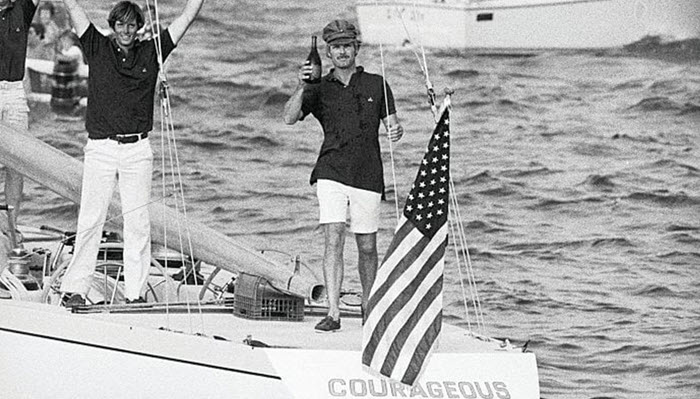
The Defense trials were somewhat closer. However, the lingering doubts about Ted Turner within the hierarchy of the New York Yacht Club persisted. Many years later, Gary Jobson opined that:

“I think the New York Yacht Club realized that Turner had the talent and the crew was good, and Courageous might be the right boat, but what about this mercurial southerner? Should he really be representing the New York Yacht Club in the America’s Cup? I think those of us in the boat bet they were looking for any excuse to get us eliminated and the only way to keep going was to keep winning.”

And win they did, starting the defense trials with five straight wins before finally losing a race to Ted Hood’s Independence. For Lowell North’s Enterprise, it was a difficult start, losing two straight races to Courageous and then sharing a two-race day with Independence.

North was tinkering still with Enterprise, and after another shared day with Independence before fog ruled out sailing for two days, he was fired, with Halsey Herreshoff coming onboard to boost the afterguard and Malin Burnham instated as skipper.

It had little effect initially, and Turner was quick to capitalize on the disarray in the Enterprise camp, thumping in two victories as racing resumed and a further victory against Independence the following day.

Hood’s hopes were fading fast too, even after replacing tactician Scott Perry with Steve Van Dyck and two further defeats by Enterprise and a 1 minute 23 second victory by Courageous saw the straw boater wearing Committee of the NYYC thanking Hood for his participation and excusing Independence from further trials.

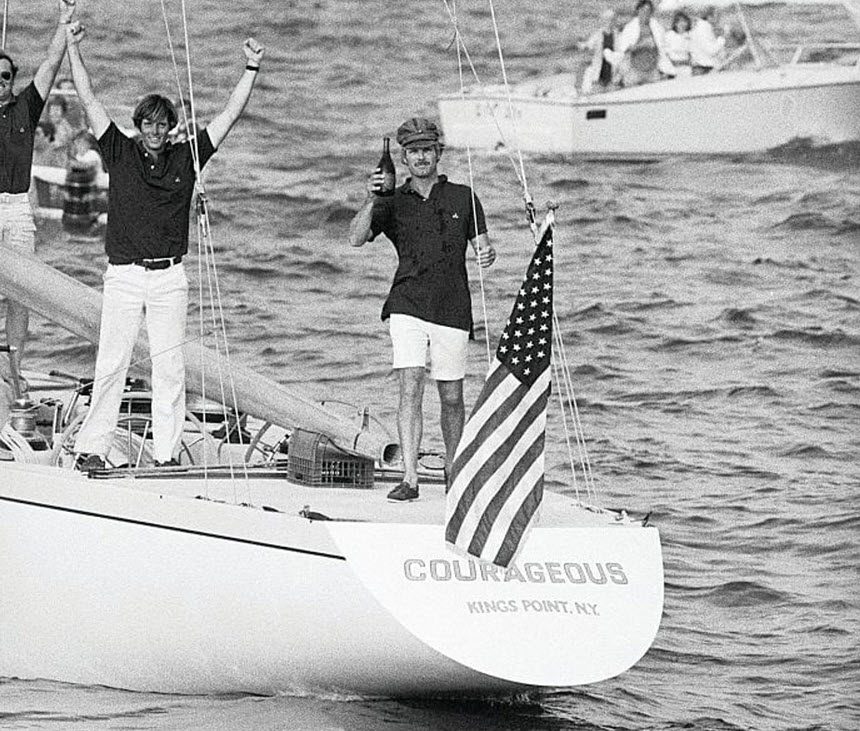
Turner sealed the Defense nomination for Courageous the following day on Tuesday 30th August 1977 with a resounding, tactically brilliant race against Enterprise that saw Courageous on the right side of two shifts on the first leg and, never headed, sailed off to a 1 minute 26 second victory.

There was no other choice, Courageous with Turner, the ‘Mouth from the South’ was the nominated Defender for the America’s Cup, having lost just one race from 11 in the trials. Devastating performance and right when it mattered.

After being informed of his nomination to defend the America’s Cup by the NYYC Committee, Turner had commented: “There will never be a time in my life as good as this time. I can’t believe all this is really happening to me.”

So, with confidence high, the crew of Courageous, led by a skipper very much at his prime – Turner was 38 years old – the Americans faced a familiar foe, one they had encountered many times on the global grand prix yachting circuit, in Alan Bond.

Bond’s campaign had been one of steady improvement, something that had been monitored from afar by the Courageous syndicate who knew they were facing a much faster threat than Southern Cross posed in 1974.

The Australians also had controversially brought in match-racing ace and American national Andy Rose to the afterguard as tactician just before the semi-finals of the Challenger Series, and the move seemed to work with Rose gelling with skipper Noel Robins well. All was set for the 1977 Match.

It was September 13th, 1977, and Newport, Rhode Island was cold with a 12-knot breeze blowing from the south by the time the boats arrived at the racecourse after the customary long tow out from their Newport bases.

The pre-start circling was naturally aggressive as had become the norm in modern match-racing and with just 30 seconds left on the clock, both boats hardened up on timed-runs to the line on starboard tack. Gary Jobson, tactician on Courageous, called for Turner to hold the right and in the dying seconds, Turner tacked off on to port leaving Australia to head for the pin end of the line.

Both boats were late for the start line but with an expected veer out on the starboard layline, Australia came back on to port to follow Courageous after five minutes of windward work. With Courageous able to point consistently higher, the gauge visually decreased over a port tack leg that lasted for some 17 minutes.

When Courageous tacked, she was easily crossing Australia so Rose called for a tack beneath in what should have been a relatively clear leeward position, but the call was too late and Turner just eased Courageous over the top, blanketing the Australian’s sails.

Robins tacked immediately, a move that Turner ignored, electing to sail out of phase to the windward mark. It was brilliant tactical sailing in the conditions and Courageous rounded mark one with a lead of 1 minute and 8 seconds and headed off on a reach to the wing mark, setting her spinnaker with perfect crew co-ordination.

The expected offwind performance of Australia failed to materialize on the two reaching legs and Courageous was ahead by 1 minute 23 seconds at the first leeward mark, but closed up on the next beat courtesy of a favorable 20-degree windshift.

Encouragingly though for Courageous, whose tactician Gary Jobson had casually recorded the speed of Australia whilst training some weeks earlier and had chosen to keep the data to himself, the final run saw Courageous extend marginally before turning for home and stretching away. The final delta was 1 minute 48 seconds with the Australians ruing their choice of headsail and a lay day was called to re-group.

When the boats came back out for race two on the 15th September 1977, a rather familiar pattern began to emerge – that of Courageous being able to pinch higher to the wind than the Australians – and despite the race being abandoned as the 4:40pm time limit was breached, the Australians knew they had a problem with the American’s speed and point.

When race two was re-run in just 11 knots of southerly unstable air, it was the sort of conditions that Ben Lexcen and Johan Valentijn had in mind when they designed Australia. However, Turner made the best of the pre-start, trailing Australia down to the committee boat before gybing first and setting up in the leeward position, confident of his boat’s ability to hold and gain in a lane.

However, Australia held solid to windward for the opening minutes, and when Courageous tacked to come back on port, Turner, unable to cross opted for an aggressive lee bow tack setting right up underneath the Australians and it was effectively the move that won the race. Australia was forced to tack off and in doing so, opted to change headsails that cost them time that they could simply never make up. Courageous led by two minutes at the top mark.

Australia, though, were in this race to fight and despite rounding the leeward mark after the first two reaches, some 2 minutes 48 seconds adrift, managed to take 30 seconds out of Courageous on the second beat. With the wind building up to 15 knots for the run, Australia closed by another minute, setting the two up for a final beat where Courageous tenaciously covered to win by a delta of 1 minute and 3 seconds.

It was 2-0 to Turner and the defense of the America’s Cup was on.

Race three dawned as a typical Newport late summer day with fog reluctant to lift and a persistent drizzle blowing around on an 8-knot unstable south westerly. The pre-start was an anodyne affair with the two boats shadow-boxing in the circling and never really engaging. In the final moments, Courageous had set-up to leeward and ahead on starboard tack for the lead into the line.

With no other option, Robins wheeled away onto port, crossing some six seconds down and heading right. Turner and Jobson realized that they had to keep close in the veering wind so tacked over to cover after 45 seconds and a long drag race ensued out to the west.

Spectators observed that at various times, both boats locked into favorable shifts that put either one ahead, and arguably if Australia had tacked on one noticeable header she would have at the very least engaged with Courageous. Robins and Rose didn’t take the opportunity, claiming afterwards that they would not have been able to cross (but they didn’t have to?) and when the wind came back in favor of Courageous, the race was as good as lost.

Turner and Jobson were in marvelous sync, rounding the top mark 1 minute and 50 seconds ahead, and despite the breeze veering on the first reach causing both boats to gybe, by the first leeward mark they had extended to just over three minutes ahead.

That lead was extended further on the second beat to some 3 minutes 27 seconds before the Australians clawed their way back into the race on the final run as they brought down extra pressure and rounded 1 minutes 57 seconds astern at the final leeward mark.

Courageous kept a close cover on the final beat to cross the finish line and record a 2 minute 32 second victory as the “Rocky’ theme tune blared from a Coast Guard cutter. The writing was on the wall for Bond’s Australia campaign but, ever the optimist, in the press conference afterwards declared that more breeze would favor the Australians and that a better performance was on the cards. It was false hope.

The final race begun in some 14 knots – the wind Gods had answered Bond’s prayers – but the differences between the two boats were perhaps amplified by the conditions. Both boats started on port tack with Courageous to leeward and pointing so well that Australia just couldn’t roll over the top and was forced to eventually tack away.

Turner followed in quick pursuit and, now on starboard, held the advantage. Robins tacked and ducked the stern of Courageous and the call onboard the American boat was to stand on with the afterguard believing they were in a lift, and it was a full two minutes before they tacked to cover. When they did, the cross was easy, and the lift thus confirmed.

At the top mark Courageous was 44 seconds ahead and headed off on the two reaches with confidence in their downwind speed to stay ahead. By the leeward mark the Americans had stretched the lead to 56 seconds and as the wind began to drop, the second windward leg saw a tactical masterclass of Newport sailing as Courageous streaked into a 2 minute and 11 second lead that they further extended on the run.

By the finish line, it was a slam-dunk and the winning margin was 2 minutes 25 seconds as Newport went wild for their new hero in Ted Turner.

Much has been written about the immediate aftermath of the 1977 contest, and in particular an unfortunate, rather intoxicated, press conference that occurred immediately after the racing. However, some 32 years later, Jobson offered a snapshot that summed up that summer beautifully: “I think the ’77 Cup race was a high point of our lives. We were the underdogs going into that summer. We were going to have to perform at an absolutely superlative level. It was a crew of 100-percent winners.”

The America’s Cup had been defended in style by one of the true mavericks and characters of the event’s long history and the Auld Mug was safe once again in West 44th Street, home of the New York Yacht Club. Ted Turner meanwhile had: “rocketed from famous to superstar,” according to the New York Times.

The rest as they say, is history.

Details: https://www.americascup.com/

A Mexican surveillance giant you’ve never heard of is now watching the US border

 A Mexican surveillance giant you’ve never heard of is now watching the US border - Rest of World


A Mexican surveillance giant you’ve never heard of is now watching the U.S. border

Grupo Seguritech quietly built a $1.27 billion surveillance empire. Now it’s expanding into the U.S. and across Latin America.

Adriana Zehbrauskas for Rest of World
By JOSÉ OLIVARES
8 APRIL 2026 • CIUDAD JUÁREZ, MEXICO
TRANSLATE


This article was produced in partnership with Type Investigations.

Inside a law enforcement command center in Ciudad Juárez, a police officer scrolled across a map on her touch-screen computer. As she used her fingers to navigate through the Mexican state of Chihuahua, where Juárez is located, different colored bubbles lit up. “That one is a camera,” the analyst explained, pointing at a circle. “We can just click it and see the live view.”


Listen to story30 MINUTESLearn more


0:00/30:491X

“Look,” an analyst next to her said, demonstrating how the technology works. They zoomed in on a camera feed inside the women’s unit of a state prison. On screen, the camera focused on a group of women sitting around a table — the details of their playing cards clearly visible.

For decades, Juárez, which sits just across the border from El Paso, Texas, has been considered one of the most dangerous cities in the world. For years, rival gangs and drug cartels have battled for control of the city. To combat the violence, Mexican authorities have engaged in an ongoing fight against criminal groups in the area using surveillance technology.

This command center is key to Chihuahua’s growing surveillance network, Gilberto Loya Chávez, the state’s square-jawed and charismatic secretary of public security, said during a tour of the facility last October. Behind him, large screens blasted live camera feeds from throughout the state, as more than a dozen analysts typed away on computers.

Win With Style. Lose With Style

 Win With Style. Lose With Style.

Originally published in 2013, this message from Clemmie Everett provides a reminder that how we play the game impacts the health of the game:


If a tree falls in the forest and there's no one around to hear it, does it really make a sound? I don't know, but if a sailor can win a race but there's no one to race against, can the sailor really win? Pretty clearly, the answer is no.

Sailing is a great lifelong sport that encompasses a range of ages, abilities, and degrees of seriousness, and one aspect that's vital to keeping the sport going is sportsmanship. It's often said that sailing is a self-policing sport and that for this reason, sportsmanship is particularly important.

However, it only takes one incident with one boat abusing the system to make a race less enjoyable for everyone else. Following the rules is certainly a significant piece of sportsmanship, but being a good sport in sailing goes beyond rules and the racecourse.

It's one thing to think about how to improve your boathandling or tactics, but thinking about how to be a better sport is a more difficult - and more important - task. It's relatively easy to think of ways to be a bad sport, but are there concrete steps to being a better sport? There's certainly no right answer, but here are a few things to keep in mind as you approach your next race or regatta.

1. Show your appreciation. Thanking the race committee, regatta organizers, your competitors, and any friends, family and coaches who helped get you to the starting line goes a long way to making sure that a positive racing atmosphere will stay that way.

2. Be prepared. If you have the parts, clothing, and information that you need for your time on the water, you'll be less tempted to grab a part from a boat in the parking lot or "borrow" the spray top you find in the bathroom. You'll also be less likely to feel like you've suffered for an "unfair" reason (like your traveler snapping or not knowing the starting sequence) and take out your frustration on others. - Read on

Kindle users get crafty as old models stop working

  Kindle users get crafty as old models stop working

Jailbreaking kindle

Niv Bavarsky

Paperback diehards who claim to love lugging around Ron Chernow doorstoppers are getting vindicated. Today, Amazon is ending support for Kindle e-readers released before 2013—which prompted some users to load up on books or alter their devices.

While the titles already loaded on the gadget your parents gifted you in 2010 aren’t going anywhere, the owners of the ~2 million older Kindles still in use won’t be able to acquire new books from the Kindle Store.

  • The change affects more than a dozen models, including some Kindle Fire tablets, the Kindle Paperwhite 1st Generation, and the Kindle Touch.
  • Amazon is offering a 20% discount on new Kindles and a $20 credit for e-book purchases to those trading in qualifying older models.

But some aren’t rushing to Amazon.com

Many scrappy bookworms are now sidestepping the Amazon ecosystem by sideloading titles onto their vintage Kindles from designated apps on their computer.

Others are altering their Kindle’s software—a more technically involved process known as jailbreaking that may violate Amazon’s terms of service (though not always the law). This allows them to install alternative reading apps with more features and download books in formats that aren’t compatible with ordinary Kindles. You can see how people are doing it here.

Many users are angry…accusing Amazon of practicing planned obsolescence and exacerbating the issue of e-waste, with some saying they’ll switch to competing e-readers. Amazon currently controls 72% of the e-reader market.

Investors are pulling away from AI on a global scale

 Investors are pulling away from AI on a global scale

Investors wary from Iran war

Spencer Platt/Getty Images

Investors around the world are dumping tech stocks like they’re toxic cast members on Love Island. Tuesday continued a global sell-off in tech that may be a sign that traders have become skittish about the long-term profitability of AI and chipmakers.

The abandoning of the AI ship began in the US on Monday before spreading to Asia yesterday and resuming in the States after the other side of the world went to sleep:

  • South Korea-based chipmakers SK Hynix and Samsung fell more than 12% yesterday, resulting in a 10% decline in the Korean Composite Stock Price Index.
  • Magnificent Seven stocks finished down 1.5% as a group yesterday, with only Microsoft and Amazon showing a gain.
  • Other US-based AI companies to take a hit included Broadcom (-3%), Micron (-13.2%), AMD (-5.8%), Intel (-6.1%), and Marvell (-9.4%).

What’s causing the sudden loss of confidence?

Much like a couple trying to decide what to have for dinner, no one has a definitive answer—but there are several plausible options.

Google/SpaceX dips: On Monday, both companies took big losses—Google dropped 5%, while SpaceX fell 16%. Some analysts believe that was enough to trigger the sector-wide selloff.

Interest rates: Most forecasters believe that the Fed will raise rates by at least a quarter-point this year. Bank of America predicted on Monday that there will be three hikes, totaling three-quarters of a point, in 2026. Higher rates could result in a deceleration of the heavy investing in AI technology that tech companies have planned in the coming years.

Spending. Investors periodically remember that they’re worried about the hundreds of billions of dollars that tech giants are investing in AI.

What’s next: JPMorgan analysts suggested that the anxiety could be related to Micron dropping its earnings report this afternoon. The chipmaker is expected to provide insight into whether the demand for AI infrastructure will remain high...or if the panic will continue.

How does the Fed work


So how does the Fed work? Glad you asked! USAFacts Founder Steve Ballmer just dropped this new video on the Fed and we couldn’t wait to share it with you. 
Join Steve as he breaks down the Federal Reserve's complex role in the American economy. He'll break down complicated concepts, provide visuals to shed light on the institution, and even make a few costume changes. 
 
This is the first Spotlight edition of the USAFacts newsletter, which we’ll send when we have a cool new way to explore data with you. You can expect to get them about once a month. 
 
Here's a preview of what you'll find in the video, plus data to understand the Fed's role in your economic well-being:  
The Federal Reserve is the most important bank you’ll never use.
  • It’s a bank for banks. It holds cash reserves, moves money between banks, and can lend to them whenever needed.

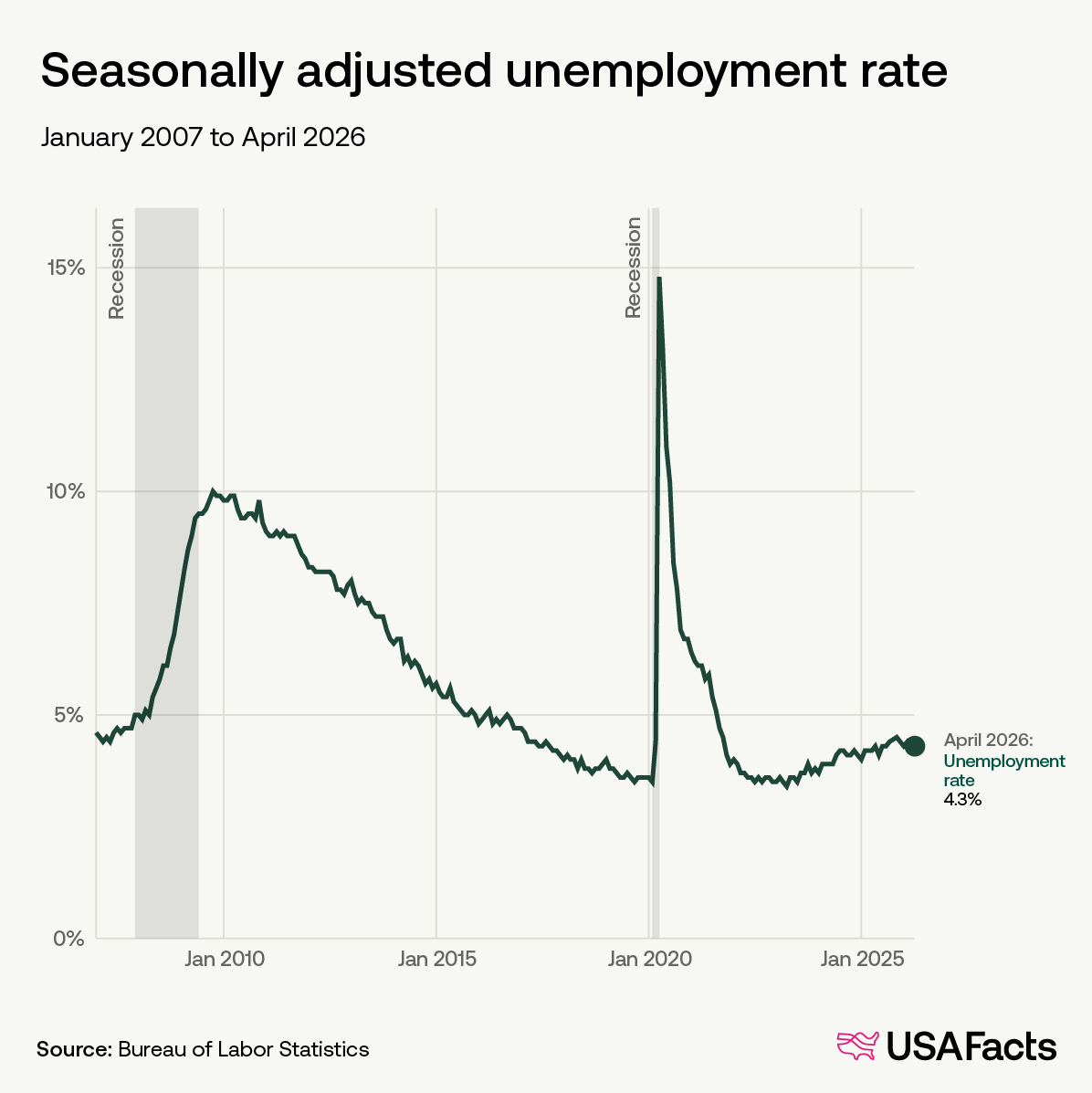
  • The Fed has five responsibilities. The one that affects you most directly is its mandate to conduct monetary policy to keep inflation in check and employment high. Through it, the Fed can influence interest rates across the entire economy. (Here are the other four.)  
Speaking of inflation
  • When the Fed lowers interest rates, it can lead to the running economy “hot.” It can make it cheaper for you to buy a house, get a car loan, or borrow money to open a business. But if money’s easier to borrow, it can fuel inflation.

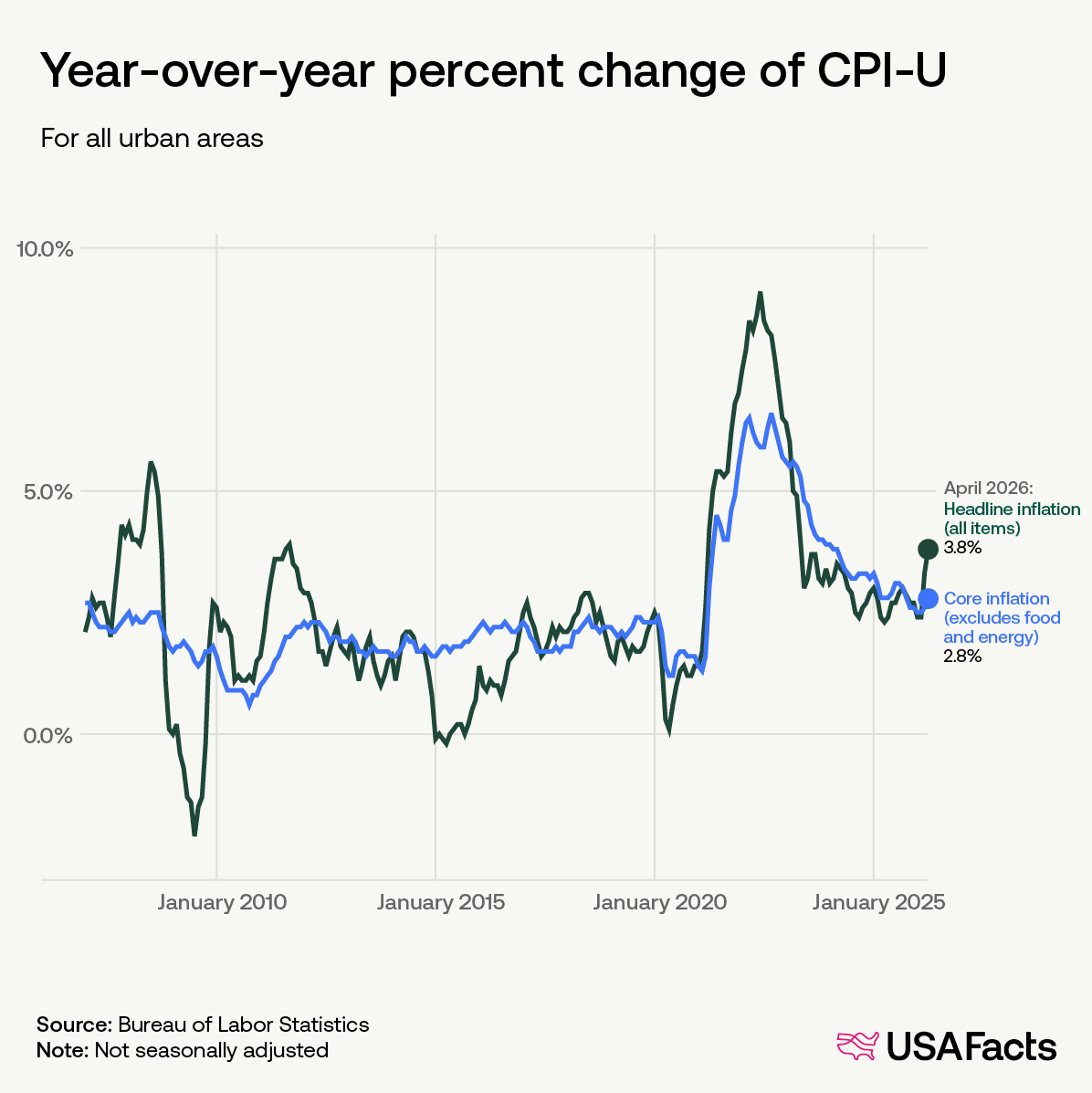
  • Last month’s inflation rate was 3.8%. The Bureau of Labor Statistics measures inflation through changes in the Consumer Price Index (CPI), a metric designed to track the price of a “basket of goods and services.” 
  • Think a dollar doesn't go as far as it used to? You're right. Track how the dollar’s value has changed with our inflation calculator! Explore the value from 1913 to now, or at any point in between.

  • Workers’ wages aren’t keeping up with inflation. Nominal wages rose 3.6% from April 2025 to April 2026, while prices grew 3.8%.

  • When the Fed raises interest rates, it can lead to the economy running “cold,” making things more expensive and slowing inflation. When borrowing is hard, it can slow the economy and drive up unemployment.  
How the Fed influences interest rates
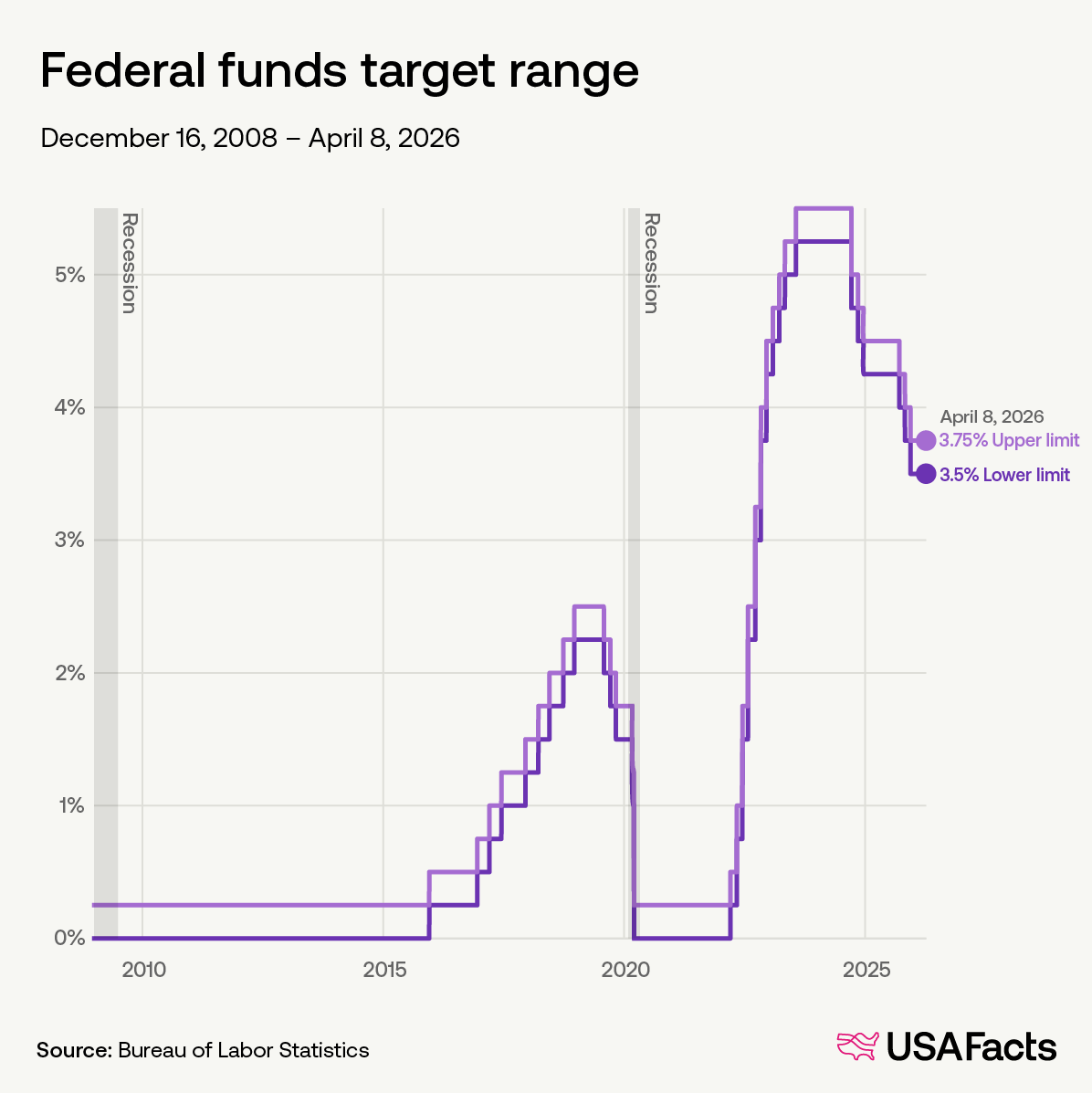
  • The Fed changes the interest it charges on loans it gives and pays on other banks' cash reserves it holds, effectively setting the limits at which other banks can charge interest. The average overnight rate at which banks transact is called the federal funds rate. Get a jargon-free explanation of the federal funds rate from Steve himself.
  • If the Fed raises the federal funds range, your bank’s costs go up. Your bank might raise interest rates on new loans. Mortgages, car loans, credit cards, and short-term business loans all get more expensive. That can ripple across the economy: people buy less, inflation can decrease as demand falls, less demand means companies may need fewer workers — causing unemployment to rise.

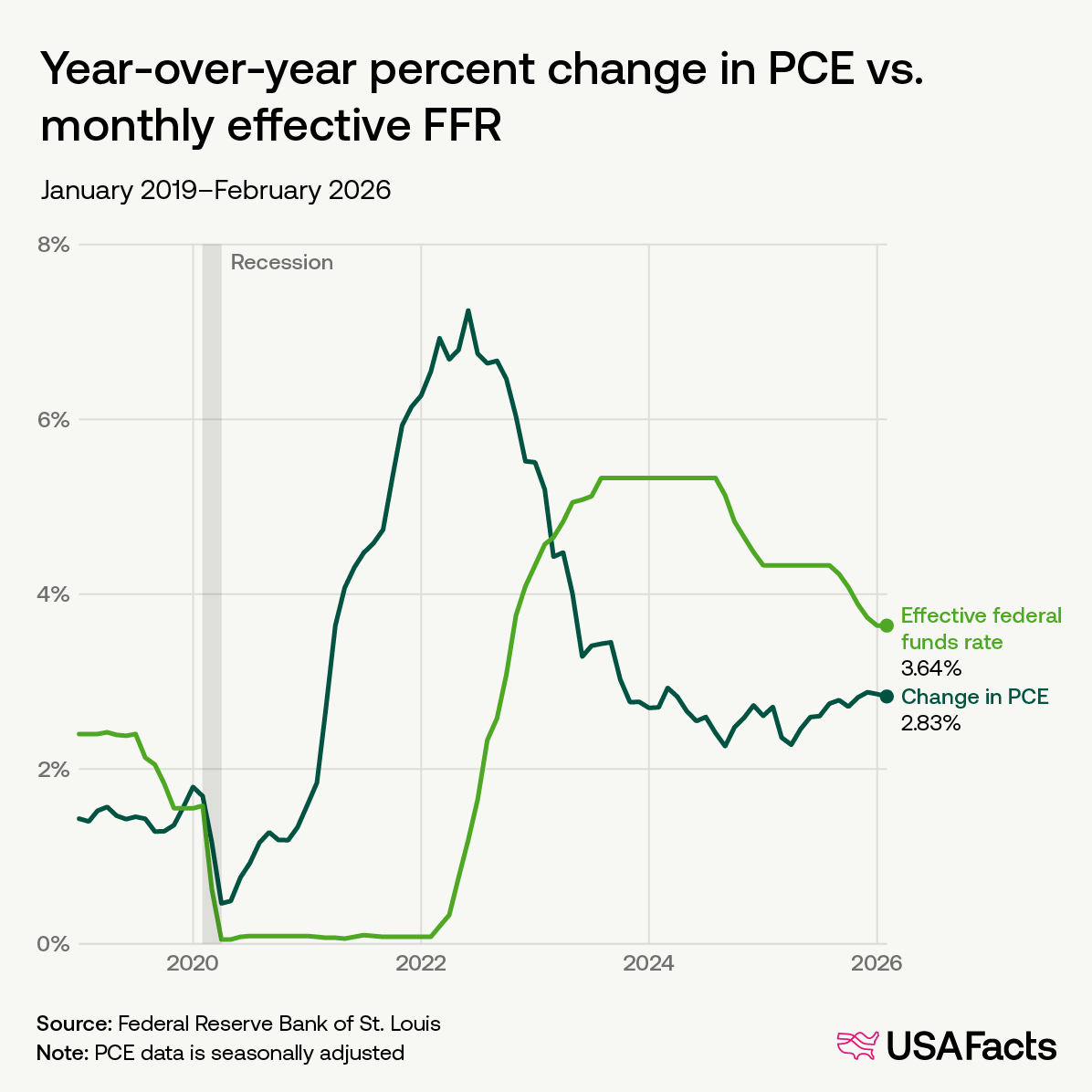
  • The federal funds rate target range has changed about 30 times in the last 10 years. In 2022, inflation climbed well above the Fed’s 2% goal. In response, the Fed raised the federal funds target range seven times in a single year. 
  • The Fed uses the Personal Consumption Expenditures Price Index (PCE) to measure inflation. The PCE tracks changes in the prices consumers pay across the economy. This differs somewhat from the CPI (the inflation measure most Americans are familiar with) because the two indexes use different methods and baskets of goods and services to calculate price changes.

  • Sometimes interest rate changes aren't enough, so the Fed uses other tools. One of them is to create money. (Sounds nice, right?) Here’s how
 
Thank you for joining us for this first Spotlight email! Watch the video now, then learn more about the Federal Reserve

RG Richardson Communications News

I am a business economist with interests in international trade worldwide through politics, money and banking. Interactive Internet VoIP and secure eMail Communications. The author of RG Richardson City Guides has over 300 guides, including restaurants and finance.